Google Ads for Tour Operators: A Guide
If you run a tour or activity business, you already know the problem: SEO takes months, social media algorithms are unpredictable, and OTAs take 20-30% of every booking. Meanwhile, you have empty seats tomorrow.
Google Ads solves the immediacy problem. Someone searches “book a snorkeling tour in Maui” and your ad appears at the top. They click, they book, you make money. It’s the most direct path from advertising dollar to booking confirmation that exists in digital marketing.
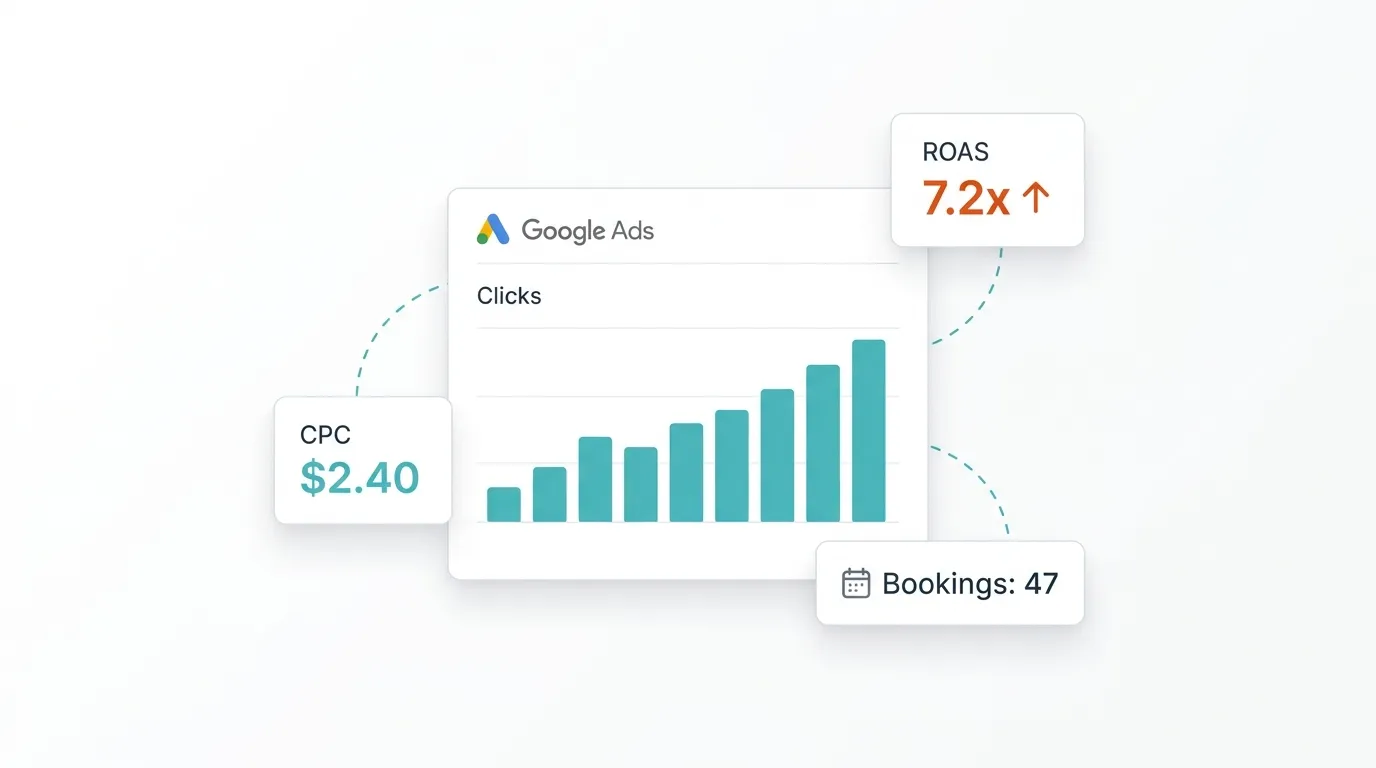
But here’s the thing — I’ve watched tour operators light thousands of dollars on fire with Google Ads because they didn’t understand the mechanics. Broad match keywords eating their budget. Traffic landing on their homepage and bouncing. No conversion tracking, so they couldn’t tell what was working. The difference between a Google Ads campaign that returns $8 for every $1 spent and one that loses money comes down to a handful of decisions.
This guide covers those decisions.
Prefer video? This playlist walks through setting up and optimizing Google Ads campaigns for tour and activity businesses, step by step.
Read the transcript
0:00 — Hello everyone and welcome to profitable PPC campaigns with two uh for tour operators with Vitaly and pablo very excited to be here I'm very excited that we have a decent turnout today um this is a three-part workshop that we've got going on um uh starting today we got another one tomorrow and another on um on thursday and we've worked for the last few weeks to break this down in such a way
0:35 — That you should have a profitable PPC campaign running by the end of this workshop and I am uh thrilled to be here if you guys have any questions throughout the presentation uh and you are in the Facebook group you can uh leave a comment say hello right now and tell us where you're logging in from uh looks like we got seven on board already about 50 have registered so it should be a
1:06 — A fun class and we'll all do this together as a quick heads up I will actually also be uh doing the actual setup of these campaigns after each class so pablo is going to come on board and he's going to essentially uh show us the all the mechanics and he's going to show us the case study that he uh has been able to accomplish and after each class I'm actually going to be doing the the the homework and I'm going to be
1:38 — Building the campaigns per pablo's recommendation and specifications uh live live stream in the uh in the group so you guys are welcome to join me for those as well and you can do it with me you can watch it and do it yourself later on but however that goes uh of course the goal remains the same to build a fantastic uh a profitable PPC campaign hello frankie hello jason hello simon thank you guys so much for for uh for joining us thanks for
2:11 — For participating uh pablo is here with us now pablo how are you doing today you're on mute right now my friend all right heavy teddy thanks for having me absolutely glad glad glad to have you have you here and thank you so much for volunteering your time uh on teach tour operators how to run profitable PPC campaigns very excited to learn from you thanks for having me yeah of course well so how do we start with daddy just share my screen and go ahead with the webinar
2:46 — Well let me introduce let me introduce you a little bit um I think it's I think it's important I think some of the uh I think some of you have already seen uh you know the work that uh pablo has done in some of the emails that we've sent out um and pablo essentially comes from the tour res tech industry he's been in digital marketing and the digital strategist for many years and he has uh an agency called la hype and le hype uh does a whole suite of
3:20 — Different services for the tourism industry they do SEO PPC uh you know web web design they do a lot of different work and when we were chatting he mentioned that he was running these really profitable campaigns for a boat charter client of his um and I was like well how much are you making it was like 500 ROI 600 ROI and he's like well hang on let me calculate it and I can actually send you some of these numbers and he he sent me he sent me his numbers and I was like holy crap I want I want those I want campaigns like that
3:53 — Because for every dollar that they were putting into campaigns they were getting 31 out that is a 31x return on ad spend um and that is not an easy feat uh uh I think that I've heard you know people say that if they're getting those types of results but I actually wanted to see it from like to you know in my with my own eyes so I can see that it could actually be done and so very excited to be learning this very excited to be implementing this um pablo has done an amazing job of breaking down the fundamentals of PPC
4:26 — Campaigns and kind of the core elements of each and he and I throughout this entire kind of workshop will be um you know kind of playing off each other going back and forth a little bit you know I'm probably I'm gonna I'm gonna question some of the assumptions he's gonna tell us about what he learned he's gonna go through his entire process uh he's also done a great job of building some of the workshop worksheets that we can essentially use directly after um each of the work uh classes to actually do some of this
4:58 — Homework so very excited thank you all so much for being here um without further ado pablo let's fire up that presentation all right um I'm gonna start by sharing my screen if you can just confirm that you can see it I see myself good all right let's kick it off very good all right so um basically what we have first of all prepared for you guys here
5:30 — Is uh just a quick uh glossary because we realized while we were rehearsing this and building up this uh three classes that we are going to have for you guys um that some of the terms they might be a little bit too technical right and I tend to use quite a lot of technical terms so if that happens this is going to be your place to go to kind of just get the the terms right to understand better get the best out of this webinar really so this first class is gonna be we're gonna be looking basically at uh marketing research
6:02 — And what we mean by that is not just uh understanding um how to make ads itself we want to make a quick bridge just to talk a little bit about why are we able to do something like paid ads today uh we want to talk about the customer's journey which is always going to be present when we're doing marketing work now for tourism there are some clarities which I would like to go over and lastly and we're going to be talking about the keywords um which are essential for any kind of work with search engines uh be it paid be it organic you need to know your keywords you need to know how
6:34 — To make this research um this slide is about us I think you already did a good presentation but vitality maybe just want to give a sum up sure yeah um by the way uh quick quick note can you dismiss that bottom uh note that says hide and then uh also guys you should know that uh you will be receiving uh all of this material in the group it'll be posted so the whole presentation will be in there the worksheets will be in there everything will be inside of
7:07 — Um of the of the group and and as we're doing the work and as you're working on all on the worksheets and as you're working on your campaigns you can comment in there and and both pablo and I will be very active making sure that uh that you guys are success as successful as possible okay um so quick background on me uh I spent over 10 years in silicon valley I've worked for a number of high growth technology companies in a number of different industries and verticals uh I've generated over 100 million dollars in
7:38 — Revenue for those companies somehow I ended up starting a yacht charter company in the canary islands in tenerife we do yacht charters and whale watching tours uh first year we did 240k we struggled a lot spent a lot of money made a lot of mistakes and then second year we did 450 when we were on track to double that in our third year and then of course coronavirus hit and throughout that journey I realized that uh tour operators have very little support there's so much information that we could use to leverage what's working what's not the communities
8:12 — And uh that's why during this kind of downturn uh during covet I decided to launch a new travel association that is primarily focused around helping tour operators around the world grow their businesses so that is why we are now doing these types of workshops and we will continue to be doing these types of workshops and if you're interested in learning more about that you can go to travelassociation.org where we actually earlier this week launched a splash page where you can learn more
8:48 — Go ahead perfect um well myself as Vitaly said I came from the digital marketing ambiance um I'm graduating in advertising and I focus especially in SEO and business intelligence applied for digital marketing I grew my years like that um and uh like why am I here now talking to you guys on the tourism fields really as Vitaly said because I joined the rest tech industry um a couple years back uh we picked up that the industry really
9:21 — Did have a big gap of marketing support um the there's a lot of software there's a lot of consultancies there's sometimes very focused agencies which do one specific thing but we did not really find a competitor so something that we wanted to offer which was being able to recover from tail to bottom all of the of the aspects that the tourism agency really needs and that made us create the hype which by now has been working with over 32 operators and we have been doing this
9:53 — For three years lots of ups and downs we have we are still learning a lot it's a very cool industry to work in because it changes and the glad thing is that um digital marketing change is with it right it's super fast so we're happy to do to be working with the industry we're happy with the results we're having and at least for now I don't think we're going anywhere so we're also very happy to be working now with ita in this kind of workshops and spread a little bit more about what we know so with that guys um I'm gonna present
10:28 — Quickly uh who is our success case because um this charter company a crazy crab it's uh it was founded in 2018 sorry in 2016 in the cayman islands uh basically uh the region is very it's it's perfect for um water activities for charters and it has some of some main attractions in the region which um you did find a lot of offerings in which you could hire a specific charter company but they would give you that specific com experience you know like they would say
11:01 — You're hiring the two hour charter which is going to do disciplinary and crazy crap actually had a different approach they had at the time one vessel and they wanted to give an a personalized experience they wanted you to be able to tailor your activity the pace that you want to do these things maybe you want to spend more time at one activity than the other maybe you want to snorkel for a little bit longer and they want to adapt to that um with that in mind uh troy leecock which was the owner and is the owner of crazy crap he came to the hype and he mentioned a couple of key aspects he would like to
11:35 — Tackle um he actually came in to talk for the first time about SEO which is another topic that we could talk for many webinars but basically we he looked at um he wanted to increase his bookings without having to increase too much on his staff side so it was very important for him that we reduced the office time that he had to make the management of the bookings to make the engagement back and forth some guiding the user to choose which at the end of the day was the best charter combination for him because that was not that common for the charter
12:07 — Industry so um increasing bookings decreasing office time he already had ads running so we wanted to optimize those and get a better ROI from investment and make sure that he's reaching the right people with the right messages and sending traffic to the correct pages and um as another point that we also tackled which did have an indirect effect as well on the ads is the organic rankings and the quality of the traffic that we were that we were bringing in so for us basically uh for crazy crap to be successful we
12:40 — Need to go over three main things which would be uh the improvement of this presentation and of his activities um that basically uh resumes or translates to build you a brand new website and make sure that the all the pages have the correct answers that we need that we're working with the right visuals that it's very clear for the user how this website works how you're going to book your activity at the end and of course then also reworking the PPC strategy making sure that with this new brand brand new website we're now able to shoot traffic
13:13 — To these specific pages we're happy to say that the results were excellent I'm benchmarking the first year of activity with lehigh pier basically we saw an increase in bookings immediately after the launch of the new website we onboarded crazy crap around april in 2018 we seen that investment in ads was a sustainable one so we also increased the ad spend there and uh the results of all of this and looking at it from a business perspective is that crazy crap was able to hire uh
13:46 — Three new vessels so they they quadrupled the capacity and I know in less than a year based from the sustainability that we were bringing from traffic from sales from growth we had long-term strategies short-term strategies but um of course now as everyone knows with corona this changed right we had to adapt our strategies we had to relook at our revisit our budgets and where we should put our investments in um but that's something we're going to go over in a little bit so right now I want to go a little bit
14:19 — On uh talk a little bit about marketing strategy and I want to touch point on two main fronts and really not take too much time here but just to give you kind of the background of what is outbound marketing and what is inbound marketing you see when it comes to onboard marketing a lot of people relate to that as the traditional marketing is the marketing in which you are usually paying for some kind of media vehiculation so you want to reach someone you don't know who you're reaching you might have some some information about it like for example if you have an
14:51 — Outdoor you might know the region where the outdoor is who tends to be looking at that outdoor from these media departments that we have all around the world same with radio say with tv um but um the the other key aspect for outbound marketing is that you are interrupting someone you're not really being they're not looking for you they're not necessarily um not necessarily aware of your offer or your brand but you might as well come and interrupt this is really flash sales on you know the normal and day-to-day business that
15:23 — We see the marketing that we grew up to look let's say um the touring activities that could translate to a sales guy on the street and talk try catching up giving flyers a radio spot a tv ad that you might do a magazine in which you're publishing one of your activities but then we also have the other side of that which is then mod marketing which is my personal favorite and I explain why the internet has given us the possibility to actually reach to a lot of people and the process doesn't have to be one way anymore
15:55 — You don't have to just um pay for ads and try to reach them you can use a platform like wool in which you know that people are going to be searching for specific things and as long as you understand what they're looking for when they're looking for them and how you are able to target that you're able to beat the best answer for the questions that your customers have so here the process is actually inverted you're not going and interrupting your customer the potential customer has a need or question which you can answer and usually uh that's why we believe so so much in search engines um the search engine is smart enough to
16:29 — At least from a paying perspective like PPC understanding who has the more accurate ad for what you're looking for or on an organic stance point from SEO who has the most relevant website right who has the better content who has more links to its website but either way inbound is always going to be working and trying to bring people to you now PPC is kind of in the middle middle ground there because it is a paid media but it is in a platform that behaves for that inbound strategy but one touch point on that today but um we're gonna be talking mostly about we
17:03 — Could say it's mostly on an inbound approach that we're working here the media because you're paying for it it's kind of in the gray zone but it's still inbound so now that we understand the internet is here to stay we know that we have new possibilities that they really the behavior of marketing has shifted at least good marketing and now we also need to understand what's our buyer's journey and maybe some of you were hearing that for the first time um in marketing we like to break this down into three stages now you're gonna find tons of names for this you're gonna find top middle bottom funnel you're gonna find
17:34 — The awareness consideration and decision stage it's all the same what we're basically trying to do is picture a funnel right the top of it it's a little bit wider you can fit more in there and the bottom it's very refined you just got one little stream but it's it's the it's a result of that funnel right it's what we're looking for so it's normal that and an awareness stage you will always have more traffic you always have more people but sometimes not as qualified not as ready to buy as some others
18:06 — Um I can give an example here with the prospect usually has some kind of need right like if you're looking at the tourism industry maybe he's looking for best places to visit in europe with kids or with family that's a very broad search if you have a company in tenerife like Vitaly it doesn't really say that he's looking for you yet does not mean that it it's not true that it is a good destination for family so you might produce a blog post about it you might make um some some content on your website about it or maybe a blog on social media but um usually on the awareness stage
18:40 — Unless you have absolutely certain certainty and you are very focused on your keywords that you are targeting the awareness stage is usually not where you want to put your money in advertising usually um on a consideration stage it's uh if you consider the middle of the funnel um the prospect already understands that let's say spain or even tenerife is a very good destination but what can I do there right which are my offerings what's my decision point here can I um can I rent something should I visit something you know city walking or should I island hop
19:14 — And all of these um questions they we need to start presenting them so here you actually start having a little bit more inclination to the purchase notice that at the first level the person is really just looking for information on the second level they're already starting to weight that information you know what is better what's my option what should I do so here's where you can actively start advertising in our opinion because um at that point if you do someone's already now looking for things to do right what to eat what to see
19:45 — Then you can start saying you should see this you know this is a great whale watching this is great this is what you should do this is what people come here to do so at that point the consideration stage is we can call it the the entry point really for advertising because there is the awareness over the need is already there they know they want to do something in the nerve you can be that something now the decision stage it is really what it all um where we need to get to at the end of the day because this is where your business is going to be sustainable this is where you're going to sail
20:16 — And um at this point it's offering you talk about product and service you you know excel at your customer business because that's key for the tourism business you really need to make sure that after all this work of holding their hand and showing them what is a good destination what activities can you do here's a cool offer for you and at that point you need to look at you need to sell your fish right that's the last step you need to focus on now I have an example here of a paris journey which comes from the
20:48 — Uh the adventure travel association basically I think it sums up um a very good perspective a key um you know a connection between what we just talked which is the marketing funnel and the expected stages of travel uh you will see that we can clearly get those six points and align them with the middle and top on the top and bottom funnel that we just looked at so uh they consider that a typical territories journey for a purchase there is the dream stage
21:21 — In which for example um you know you have vacations and you have two vacations you start thinking maybe I should take a holiday with my loved one or with my kids or with my family or whatever it is um and you go into the consideration set so you know you have a need you have a desire now you start waiting where and why right so let's say that we decided for europe in this case and then we go into the planning stage now the planning stage is where you start thinking on schedules you start thinking of where am I going to sleep what am I going to do
21:54 — What do you want to see so this we need to start this is where we can start cooking that that middle funnel because we already know that he is going to italy maybe we can say best destinations in italy right we had a customer which was from italy which was a big dmo and um we targeted his strategy exactly like this saying um you know italy for couples is a very top level we're not going to pay for that but we're going to create a lot of cool content about that now if someone wants to know specifically if it's worth visiting the vatican for example with kids if it's okay
22:26 — That's a middle funnel then if someone is ready to book online the assistant chapel that's the bottom phone that's where we need to be but then we go into booking booking would be he realizes that be it for his hotel or his accommodation or whatever the decisions that he took from this planning stage he needs to pay for that usually um so that's where our technology comes in right the booking software is the management the back office that helps a lot not only you as a tool operator but also your customer of course um the experience itself that's uh
23:00 — Where the hype really can't help too much we can give some tips but this is with you guys right this is when when when you really do what you do you know you provide you provide excellent experiences you create memories for your customers which hopefully are going to be live lifelong um and but then that's not over so he he purchased he had a great experience with you but there is always a follow-up there's always a follow-up and why we say that is because the the last stage from someone's customer journey might very well incentivize someone to
23:33 — Start their own dreaming stage you see kind of loops back because um we can say that the most common post funnel tactic that we're going to see in the tourism industry is one that you're probably already familiar with reviews asking them how was it can you give me a five star review on Google on trip advisor buy it or expedia or whatever it is um you know that they are important you need to showcase them you need to show your reviews from other customers on your social media you need to show it on your website show authority show social proof it's not just me saying
24:05 — These are my customers saying it so I'm gonna give some examples now uh down to earth looking at crazy crap what do we do so on the awareness our top pop funnel um we have focused on ads which um captivated you know the the awoken desire that they they um incentivate you to to know more about it to they charm you right so we try to show our benefits you know amazing places family friendly happy people um things that you just can't see
24:39 — Anywhere else you know we got their attention now for those that are looking at here this is a blog post and those are two ads on social media we didn't pay for them this was shout out to an audience which was a very segmented but already known audience now for example on the consideration stages we start making some pitches now see our main offer for our consideration level here was that as I explained before and the booking was a little bit different from what we would what you were used to because you have to pick the number of hours inside of those hours
25:12 — With a specific vessel you can do whatever you want and sometimes the user didn't really know how to close that deal I don't know how many hours do I need um am I am I being optimistic here and saying that two hours is enough when it's not so um what we need to do here is try to narrow down the choices showcase my offers we need to start a conversation searching for engagement and we need to captivate we need to create authority they need to trust us so for us at the time this all resumed to a couple of posts which really were
25:44 — Targeting some of the keywords that we identified that were generating traffic for competitors or for specific websites which had a very similar pitch to ours but were not really selling chargers so it was an opportunity but the main thing for us here was to build an adventure planner basically what we did is that whenever someone reached a website we want to give them two options I know what I want to book I understand how this works checkbox and date or I need help and then when they hit the health health that the button that said that I need help or if they engage with
26:16 — Other offerings through the website in which you were asking them um if they wanted to build it how to need help to build their adventure we shot into this adventure planner which then was an interactive page in which you you know nice and fluid you click what you want to do I would love to fish I would not I want to swim with the starfish or do not and at the end you would get a result saying uh we recommend you to do all of the things that you are saying here um that you need six hours for example right now that uh from there we know the user has the answer that he needs
26:49 — Right so he could very well go to book but still we invite them that if you want we can talk to you right to me reassure you we can send this itinerary to us and receive a copy yourself we ask them for their email and their name at that point um the the sales team from crazy crap would of course get in touch um and ask them if there was anything else they could do for them now notice that between having maybe 15 emails changed or calls made during the weeks I'm trying to explain what you can do you know check out this link this is one of my activities oh this is the other one
27:21 — And you guys know this can be very tiresome and when you have a huge increase in volume this might just not be sustainable unless you hire more people more back office people but um this did not happen here the number of leads actually increased and now the website was super clear that if someone wanted to make an unattended booking without really having to worry about a thing he could but if he still wanted to get some reassurance and really see if he's doing the right decision we also gave them that option to refine his confidence now of course the last option it was also there if you wanted to get in touch
27:53 — With someone after all of that he could just what's up or just use the chat and the website for that but it was not what we were really pushing for on a decision stage this is where we as we said before why we need to sell our fish so this is where we really talked about very aggressive pitches like power catamaran which is the mentality of all of red or of our vessels are the best way to explore why here's why um the advertising that we did then this is not being boosted um to a specific audience we're giving them
28:26 — Discounts when you're going to the website we're doing pop-ups giving discounts again so the marketing here we start to understand that if someone from my from my lead base or my customers or my users they went through all my funnel and they are now stuck at the decision it's worth to invest a little bit it's worth to remind them hey I noticed you didn't buy your booking how about I give you 15 percent off you close the deal sometimes um the the place you want to give offers is here it's not in the top of the top
28:58 — Funnel because you're probably going to be wasting not money because it's actually not but not very likely he will buy on the top of funnel you are wasting effort because that offering is not relevant for him yet he doesn't know what he wants he doesn't realize that that offer is a good deal for him because he doesn't see any any value in it right yeah that's an important point baba right there I think that that's that's one of the things that a lot of tour operators gets to get get kind of caught in or early on in their advertising and marketing right is that they will do a a promotion to the top of the funnel or even at the
29:33 — Consideration the middle of a funnel right um when really discounts should be used as a mechanism to help you close the deal right not necessarily to draw people in the first place right exactly yeah exactly and you are right a lot of tour prayers when you onboard them that's what they're trying to do you know they they come to us and say man like I've been pushing no uh 500 bucks a month into into Facebook and Instagram advertising I'm even giving them a 50 off why is it not working
30:05 — Because no one's reaching it's not relevant for them right [Music] so um we have several campaign types and even more tactics so when we start combining those campaign types across different medias and channels but today I want to I want to just um quickly go over some of them but we're going to be focusing on search okay because uh the objective of this workshop is that as Vitaly said you you guys watch these classes um there's going to be qs and q and a's and we're going to be there for you and vital is going to make the homework that I'm going to be
30:36 — Assigning um so it is very important for us that that we get this through if we made this for several campaign types it would get too confusing it would probably be too much to to absorb in such a short time so we're going to be focusing on search on this workshop um search basically means you're going to Google you search for something or other search engine as a matter of fact when you search for something you're going to always get the the not always but usually you're going to get some ads on the top which are paid this that the the way Google works is like an auction
31:08 — An auction house um depending the the bids that you can give in this case are the value of the click itself but also how how big big how much of a big shot your website is how relevant is it for the user for Google for the keyword that is that you're using to search if it's relevant but search is pretty much this uh you pay you'll get the first the top of the page if you have got enough ranking if not you might get some other not as visible search ads which usually means they're not good
31:40 — On the bottom we also have display ads now display ads they mean that they are a little bit more visual right we can actually not just work with text and just copy we can pop a little bit more of image you know you can get retention so this can be used for a certain kind of distributions in which you are not yet talking to your customer you know you're just talking to someone that you suppose could be a customer for you which but really touched there on the on the top funnel part right in which you
32:13 — For example let's say you want to display your ads inside of a cruise review website like we did for crazy crap now again I don't know those customers right but there it's worth to invest a little bit why because it's a cruise review website and I know for a matter of fact that a huge chunk of the of the the tourists that come to the caymans they do come from cruises so it is probably where my target is does that mean I should put 80
32:45 — Of my effort there absolutely not but it means that it doesn't hurt me to test out 10 of my investment there to see if my display ads reach someone but um again we're not going to get too much into these different tactics but one thing I want to highlight is that you can always re-target your your user what that means then is that your ad is going to follow them through other websites I'm sure all of you when happened that happened to you guys at least once in your life you Google something you're going to shop maybe you browse the colors of that something that you want
33:17 — And then suddenly it's everywhere you go into your social media you have an ad you go into the forum that you're reading for two years already it's there as well and that is basically websites giving space selling space to go to Google to advertise what their customers want to pay for you're at basically in this case um the last uh kind of video uh which um I think most people are also uh had at least one youtube doublehead experience by now um but the the videos are definitely they're key for any kind of marketing
33:50 — Tactic that's not just true for advertising but just as any kind of material that you do you know there is there's statistics out there proving that the engagement and the attention spam to a video is of course higher than to an image or just a text that also means which is understandable it's the hardest one to get right because there's a lot of people trying it and it does take more time it's more investment right you need to have a specific technical person for that and someone who records and edits well so it's it's work but honestly it's
34:24 — Worth the hassle because of the end of the day uh the the reach that you have with videos is just overall better okay so quick question good question papa on on that right so there's there it's it's so I'm an independent tour operator as I'm I'm sure a lot of us are right that are watching this um I'm a one-man show uh not really I mean I have a small team right but like I'm essentially running all of the campaigns myself I'm setting up content I'm doing like there's so much work that that obviously has to happen right
34:56 — Like how do I how do I properly um allocate my time and resources to like this immense amount of options of how to essentially advertise and retarget and remarket and you know there's just so many different channels you know what what's the what's the appropriate kind of approach that you've seen for uh for a smaller operation so that's a very good question um it's a very personalized approach right
35:30 — I I here at the hype at least for us as well we don't have um kind of a formula you know of like um how each operator in each destination should work because it's it's just too many variables right if you don't do this personalize usually you don't just don't do a good job but um I think the quick answer to your question would be that we need to benchmark it right for example if you are running let's say your company had someone on social media right there's someone making posts and taking pictures of the customers you
36:02 — Know asking for reviews and things like that you're starting stories you know starting engagement with your users I would probably not come in and ask you to put all of your investment into adwords even if I believe in it if I know that I can get the results with it maybe it's worth to then double up on the success that you already have maybe we should be looking at boosting um the the post that you are already doing on your social medias right and maybe if I noticed that your organic rankings are super good you're actually you know you're just one step away from getting that first page I'm going to be focusing on that so there is not
36:34 — It's hard for me to really put my finger where to start what I can say is that from a process standpoint if someone hires us to take care of all the advertising so it's kind of like let's call it kind of it's not really language it's like a blue ocean right so I'm just getting into a customer I'm on boarding someone they have ads they have social media they have SEO they're doing everything they have to but they're not getting there yet where I would focus first is definitely search um because I think that's where we can get the immediate indication of is my campaign successful
37:06 — Is my keyword good are my campaign types are reasonable um if you work on on other social media advertising which sometimes is it also filters very well of course Facebook has a has a great algorithm as well but I really think that the the place where we know what I noticed that from our first step which is the inbound marketing research which is basically a benchmark we do competitors market seasonality pricing and the success rate that they're having traffic distribution basically understanding how strong are
37:38 — We what we're dealing with usually the first thing we get is we translate the keyword research into a couple of campaign ads for search so the quick answer would be search um but of course that varies right you have something already when you're already doing great work with videos I'm probably going to take my attention to that and and and I think I think one of the reasons and just from my own experience you know running a lot of different PPC campaigns for a lot of different industries this is it's one of which I mean Google makes uh a ridiculous amount of money on adwords or sorry Google ads uh
38:13 — For a reason right and that is because search allows is one of the only um channels which allows you to get into the inside the the minds of the consumer right when somebody enters a search term and they're actually searching for you know private boat charter cayman islands right uh they have a very specific mentality right there's something called a certain tent like they have an intent to accomplish something and they're trying to reach a certain result and so
38:47 — Ppc is one of the most effective ways in order for you to be able to crank that up quickly and uh and it's relatively minimal as far as uh in terms of time investment I think if I had to go and do like a youtube video for an awareness stage a consideration stage and decision stage that's quite a bit of time it's quite a bit of resources involved in actually building all of that right but if I want to set up a PPC ad and I want to essentially target anyone who's searching for cayman islands it takes you know a half a day if that you know in a couple hours
39:20 — To like set up a campaign like that so um PPC is definitely very powerful in that sense yeah it is you can collect short-term results and start them insights very quickly right yeah yeah all right thank you for that no worries um so we looked at inbound right we looked at the customer's journey and uh as we tell you said we recognize that there are different search intents in different levels right now we need to know how to make keywords how do we why why are keywords so important
39:52 — Right and then trust me when I say that they are if you don't have do a good work with keywords there's not going to be high chances that you're going to be successful with your campaigns I know that's harsh to hear but it's too true and I'll show you why um through some examples here um first of all here we have uh adjusted um some slides in which we're just showing you some parameters that you can use while you're making your keyword research um what these parameters mean is that there's different ways that Google can match your keyword with the ad that you
40:25 — Want to trigger for example if you're doing an exact match you're telling them that if you're looking for the keyword cayman island private charters you don't want pricing on that you don't want any kind of best you know top guides tips you want exactly that if someone searches exactly for those keywords you want to show your ad now I know this might sound like why would I do that right because if someone searches for private charter pricing I might as well show my my click
40:57 — Why not show my ad right it's just a word away from what I'm doing but the fact is that of course we're probably gonna have those two variations as exact next too but the cost of the click is going to be cheaper if you are very very assertive with what you want if you are able to tell Google exactly what you want it you will have a cheaper click there are it's very risky to work with broad matches depending on which kind of off level you're focusing right if you're going for a top funnel you definitely don't want to go for private charters
41:30 — Right because if I put in private charges for this customer of mining claim and first of all where are you so you might get a private charter for pretty much any charter anywhere in the world um not talking about cayman right I'm not talking about not even an activity that they have in cayman so using a broad match there it means that searches for whatever like brazil rio de janeiro um the chargers is also gonna private charges is also gonna pop up there um of course we do some extra segmentation to make sure that doesn't happen but broad is risky okay use it for things that for example you are willing to
42:05 — Invest a little bit maybe that the 10 20 of your investment to test out a new audience like you know if you really want to risk it you can go and do something like um best activities internet if right and you you take a broad match for that I would not recommend you to make a headline on your ad saying you know check out the best things to do in tennessee I would definitely recommend that you are very clear what you're offering you know this is a website but you're gonna do this but that doesn't mean that you cannot target that cert kind of query uh you probably just don't wanna answer it in the same level right you wanna
42:39 — Trigger an ad for a relevant keyword for you on maybe on the top and middle or middle funnel but you don't want really to just you know try to sell that keyword because otherwise you're not going to have success yeah and and and to kind of touch on this a little bit more as well is that early on when you're first starting it's better to be more specific and then go more broad as you expand and start seeing some results right so uh broad broad match uh Google's algorithm will do a lot of work
43:15 — Uh and try to uh guess or predict what the user is trying to find and of course Google's incentive is to get you to pay for as many clicks as possible right so um when you s when you do broad match and if you do like just cayman islands for instance or you do you do like you know your destination or or even like cayman island tours it will start to show your ad for uh people searching for things that are outside the bounds
43:49 — Of what you are actually trying to accomplish so so it's kind of it's better to start more specific and I'll show you how to do this I think I think even in pablo is going to show you how to do this uh and actually use things like broad match modifiers phrase matches to more space be more specific with the search terms that your ad is showing for yeah I think a very good example that ties back into the how to target a specific keyword can also be found here in this
44:22 — In this sheet so basically what we're looking at here is I know it's a it's quirky but it works when you try to visualize it we have something called the it's not really the keyboard density but it's kind of the how broad it is um you can see that if you think of this image here the head terms they're always going to be a very popular ones they're going to have a lot of queries and what I mean by that is a lot of searches which we're going to show you how to identify for a keyword in a bit but the more that a keyword is dense it's packed up with different
44:57 — Variations with uh when the broad mesh really is able to found huge variations like pizza right pizza you can find pizza recipe pizza delivery best pizza in town and pizza near me there's just millions of things that you could actually be wanting to do with that buying it cooking it knowing more about it knowing the story of it that's a head turn that's something that for sure it's going to have a lot of search because it's going to be present in several queries around the world but it formed from a potential for your business if you're a pizzeria in this case not a lot right different from targeting a keyword like
45:32 — Pizza delivery right using this bound to earth with the uh with for example here with crazy crap a head term could be you know I'm hopping activities close to the usa it's gonna be a lot there's a lot of countries around there but you can do that but it's not really guaranteed that even if someone oh here's an option clicks it says oh this is a game and that's not what I want we just lost money so it's very important that you focus your ads in the long tail which means it's going to be very refined and you're probably going to go more refined than broad at the beginning
46:06 — Really understanding what is my key keyword you know like I'm walking tours in spain okay that's good but I'm I am in let's say barcelona so I should actually do walking tours in barcelona that's even closer to me right so that's your long tail that's what you want to do your private walking tour put that in too you're a private walking tour in barcelona maybe you're you know on a budget solution why not put that too so what I'm trying to say is that the more specific you can be with your with your keywords
46:38 — At least on the start like Vitaly said you will be able to get a better sense of you know what's going to work here and what's not going to work which are my offerings that people are really interested in which ones should I just you know put try to upsell with other activities which are the ones that I can actually have this first contact you know charm this first time when we are working the keywords there are a couple of metrics that um I want to highlight we will be looking at
47:08 — Today at the end of the class how to build a couple of keyword researches but when you are inside of inside of Google once your campaigns are launched and maybe you already have some set up you will see that in the keywords tab there are some key aspect key metrics that I want to discuss quickly um one of the more important ones for me is the ctr now the ctr it means to convert the click through rate basically when we're looking down at this graph here just
47:39 — To explain a little bit about the metrics we're looking at the keywords right we're looking at how it matches so we're looking for a broad match so if someone says here you're at transport guide pricing this is a keyword that we want to to to bet on because we know this is one of our best activities and it is in grand cayman so there is no doubt that this is an important head term for us um it's inside of a campaign now the impressions what does impression mean every time that your ad is shown on Google be it clicked or not or be it on the
48:12 — First page or on way on the bottom that counts as an impression okay that counts as someone has seen your ad now if that was a relevant audience if that would was too broad if there was a tripadvisor ad right below you when they clicked that instead of yours that still counts as an impression um good thing is unless you do set it up to be like that which you should absolutely not you're gonna pay for that click yeah and impressions usually by default you're going in and just setting up your campaigns they're gonna be charged on clicks
48:45 — Which is the metric right here on the side meaning that again someone saw the tripadvisor ad or my ad I'm not paying for that yet if they click my ad then I have to pay my cpc which is my value per click so adwords can get very expensive depending where you are which currency you're working in how many competitors you have and how you know how positioned your competition is already um but I'm sure you will find that there is always a keyword which represents your business directly
49:17 — Even if it's just a long tail from a specific product um you know a specific experience that makes part of a product maybe you're making a walk into you're gonna go through a specific place which you know is very important like that walmart chapel and milan and things like that um you will always see that there will be a cheaper keyword for you to work in maybe it's not as popular but I bet you that it is more relevant for the user that you are looking for now just to close up here the ctr right what does that mean that's basically a a division between the rate of clicks that you get
49:52 — For the times that you have been shown on the page so um as you can see I can give an example here that uh biolumisense bay is a very popular attraction in the in our customers location uh we filter it with grand cayman right why because we have this campaign specified for the cayman islands not for offshore uh we have huge impressions but as we would expect as it's the main attraction lots of competition right now we know for example that the uh on the second keyword by the boat trip
50:26 — That people are more used in the industry and the competitors are definitely feeling that too to use the charter term right but we said but hold on why don't we talk about the keyword boat trip or boat rental or vessel rental and then we just make a copy which clearly shows that it's not you're just renting a boat and it's yours and we're showing that it's your pace it's your time it's you your crew so it is a manned vessel um and and then that made a result in which you can see that or would it have less impressions for sure we did have less impressions but we had
50:59 — Very qualified clicks you see that the quality score of that user was very high and our conversion rate at the end is also very good another uh aspect here when it comes quickly is the quality score this is a delicate one okay and being realistic with you when you launch your campaigns probably I'm not saying it's the case but probably your quality index will not start off that good um that is something that you have to build over time um there is even some incentives because it is it is a very important metric but once
51:31 — You usually between that average of six to two eight you usually stay there with those ads you don't have to worry too much about losing a place to your competition for example uh what is more important there really is how much you are paying it is an auction house after all but the quality is quarry does reflect directly on that cost too you can pay less and you can get more qualified audience it's an indication between you know my ad is about this specific keyword here's the copy here's the headline of it it then reads that ad and it goes into the page that you were shooting your
52:04 — Your your user to right so when I click you'd have to tell Google where should I send this user where it's the link you send them to a page that page is also going to be read by Google both organically and for paper specifically if you are sending it on a PPC ad it will read it because it has to calculate the quality score of that page now you're using the keyword biolume essence is that on the page anywhere if it's not Google says there's something wrong why is this huge page not talking about the keyword that you are betting on right so that decreases your quality index just try to make sure that your
52:37 — Website represents the search intent that your user has and you will be walking towards a good quality index already a quick question to everybody how are we doing how are you guys doing on time we have five minutes technically left in the one hour segment uh but uh we're gonna about to go into into some of the actual work that needs to get done here and I'm I'm just doing a quick time check um pablo go keep keep going and then I'll just we'll see how the the the comments come in
53:09 — All right so um I'm going to be name dropping some tools here that you can use some paid some free but I want to be focusing on one specifically which I'm going to use for the homework and I recommend you do two the first one is free is the Google keyword planner right so here uh this is a native tool from Google when you start making your campaigns for the first time it will bring those metrics I'm not gonna lie to you guys we don't use it too much we use some alternatives here that we actually pay
53:42 — On the side but for your first campaign and definitely very very available for research to get insights and to try to build new campaign sets it's still a very relevant tool um you probably understand that as it comes from Google there's probably going to be some limitations right as Vitaly said it's it's a biased tool right you they want you to use Google adwords or Google ads sorry but it's still a very relevant tool at least for I guess it's a good tool to familiarize yourself in a native
54:16 — Ambience you know on how these researchers work so go in have a look you know create your account on Google go into the keyword planner play around a little bit so you can so kind of understand what is got a keyword what is a bad keyword there's also ubersuggest which does have a paid and a free version we sometimes use the free one to for very specific cases you know when we like a new niche for example on an industry where not don't have any data on we might use this just to get the variations and some suggestions on what
54:49 — We could use um now cm rush cm rush is great okay like right off the bat is it's an excellent tool um but I'm going to give you a warning too with that if you are not looking at really you know doubling up on your SEO and your PPC you know making a lot of research I'm not talking just keywords here I'm talking auction websites to see how they are I'm talking uh working with link profiling which is off page or link building um SEO um understanding the traffic assumptions from other
55:23 — Players this is a this is a heavy load uh heavy load tool okay this is the full solution for or at least a very good solution for search marketing meaning SEO and PPC but if you are if you have the capacity for that if you have someone in your team who want very much benefit from that still a very good recommendation but I'm going to be focusing on this one here which is keywords everywhere this is a personal favorite of mine and I'm going to be doing a part of the homework just to show you the installation
55:55 — And some of the cool resources that this has to get you started right now with your keyword research it's an extension for chrome so it's very easy to set up as long as you use chrome of course um it can import keywords it can analyze traffic from different websites and import those keywords and so you can actually sneak peek into your competition to see what they are ranking for uh without really having to have a huge massive tool like cm rush zoom rush is going to be expensive the keywords everywhere works on a token basis so with as much as 10 bucks you can already ten dollars this being
56:29 — You can already buy a hundred thousand credits which is more than you need for this initial uh keyword research so that's the end of the first class on the theory right uh I'm gonna stop uh here to ask Vitaly if you got any answers from about the the time frame and also if anyone has any questions and this would be a good time to for you guys to send it on the chat so we can answer it we are uh good on time it looks like we have uh you know simon felipe alice brian pavel everyone said that they're still good on time so
57:01 — Uh what I'd like to get into now uh is uh you showing us how to actually do the keyword research cool all right um this is going to be a three-stage um workshop right first one is going to be on keywords second one is going to be an adwords and the copy for your ads and the third one is going to be just looking at how do we continue now so I have a running campaign what I look at what's my next step but this first one here um I can assume uh it's gonna be the the the one that
57:34 — Needs more effort at the beginning because it's really gonna kick off the rest of the work that we're gonna do it's like starting an essay right it's always hard to start once you do it just flows um so the first thing that you're gonna guys gonna do is download the file that avital is gonna be shooting over to you guys with uh with the emails now in here we have a couple of examples um from keywords that we have used ourselves um I'm gonna just quickly make a copy and I incentivize you guys to do the same when you when you get yours and I'm going to be showing you guys how
58:13 — Keyboards everywhere works so keyboards everywhere the first thing you're going to have to go do is go into their website and get an api api key um you're gonna have to pay a little bit for that but trust me um I I think the last time I paid for this was last year and I'm I'm working with this every day so it should be more than enough for you guys um you get the api key install it for chrome or firefox just nice uh forgot about that um and once you go into your setup here and you you got your api key
58:47 — You're gonna get a a key on your email right that email you just have to put the key here and you're pretty much good to go that's the basic setup that you need to do okay I'm going to show you what this tool does let's get our copy I'm just going to quickly delete this and let's say that I'm just going to work with the with the broad just to make it easier to this first research before I choose the ones that I really want to bid exact but let's say that we are a company
59:19 — In portugal where our walking tours and elizabeth okay so uh my campaign I'm just gonna call it uh lisa bone walking tours my ad group this one is gonna be about I'm gonna be trying to get keywords on my walking tours right so I'm just gonna put walking tours I'm gonna start making my research so what can I do um basic that you can do is uh you're going to um so where is it now import keywords
59:53 — And in here I can just type several keywords that I think are relevant for me now um I'm going to spend my day doing that of course but I'm just going to start with a couple just to see like where am I shooting I don't know what's the right direction to kind of start digging so I'm going to put in the classic one for my business walking for walking tour listen then let's do this walking tour as well so see how if there's enough search for if this kind
60:25 — Of maybe sightseeing is better I'm going to put portugal walking tours let's start with those we're just correcting it for some reason for me but anyways um get metrics here we go walking tours as we saw head term why it doesn't say where it doesn't say about what is it a food walking tour is it a sightseeing tour um is it a cultural one I know but as you can see a lot of search right but is this relevant for you
60:58 — Well maybe someone is in portugal yes and guys a quick a quick quick note on this as well is that you see how it says global search volume right so that's that is around the world how much those keywords are being searched all right so pablo um will you will you cover essentially if if we're essentially targeting like for instance I have customers coming from the uk mostly right or or local customers in spain who are domestic right um is there a way in keywords everywhere to
61:32 — Specify uh where those searches are coming from and where I how I should be doing that you're doing that uh keyword research in keyboard everywhere no here we really do the filtering for the location by using the the keyboard itself right lisabond portugal and so on there are other tools that we use what we can do that of course like for example semrush because it can simulate different search um robots right so different crawlers which are going to go and make that research for us from different servers around the world so it can actually be located
62:04 — In america or we can be located in germany and make us research there uh you are right that that does help a lot when it comes to make local ads right for example for example uh walking tour right as we saw too broad right globally is it's locked a lot however I can bid on this keyword as long as I'm crystal clear that I just want to show it to someone that's in portugal or at least in lisbon for example right then walking tour becomes a relevant keyword like this it does not exactly okay I wanted I wanted everyone to understand that
62:36 — Right so if you're if you're bidding on a on a term like walking tour or like boat charter right uh you don't want to show just us uh your ad for someone who searches just for boat charter uh that's not even considering your destination but if they are already in destination then that's something that is very feasible you could totally uh advertise right or show your ad to people searching for a term that that is that broad
63:07 — Because you know that they're already located where you are right exactly exactly um I want to show a couple of different hacks right because when we go into this um finding our keyboards that we just found here and getting this main metrics right that we needed the cpc the competition and the search volume of course super important um uh you don't have to that's not the only way to build it now of course I incentivize you to just know sit down get a sheet of paper and a pen
63:39 — Write down all of the keywords that you can think of for your business you know really anything is there an attraction that you go through write it down is there a museum that you might sell tickets to write it down just try everything you can the more the merrier at this point because um the filtering that you can see I would maybe my business would maybe say oh there's that's like my main keyword maybe it's even the name of my business right walking tourism lists upon but there's no search so what do I do you find variables right so just write them down the more you have the better
64:11 — Because trust me you will discard some of them that's for sure it's given um but there are some other cool things that this tool can do for example I can now look for um let's say just walking tours walking tours and lists upon so um the the extension from keywords everywhere has a couple of very cool extensions that it brings into Google itself which is a good place
64:43 — For you to research too it's going to give you the main metrics the same ones that we've seen before right let me just change this for portugal just for ease of use because it actually has volume there we go okay so here I'm seeing the metrics that I need to put into that sheet right I'm seeing that I have 320 monthly searches worldwide I'm seeing that averagely Google is going to charge me 1 and 46 dollars for this click
65:15 — And the competition this is in percentage 12 of competition so it's actually a very good keyword now if anyone can take a guess here on why this is so high on volume and so low on cost I would just say that it's because it's a head turn it's very broad the protocol is not a small country you might be in different locations you might have different intentions so for someone like tripadvisor sure they might advertise on this right by the way let me just uh stop my ad blocker here otherwise we're gonna be missing a lot of
65:48 — Information um the ad that someone creates for this um they really need to to understand that a big chunk of that investment is probably not gonna sell right but it is such a low cost for you know someone that like trip advisor viator you will always see that these kind of terms depending on the destination of course will be bad on and it's probably not going to be a very fair competition to you um so what else does this tool do you see this is some rich information that Google just brings from
66:20 — This location but down here you'll always see two excellent views which really help me when I'm doing my research which is uh the related keywords so meaning uh keywords that are you know what pop up here on the related searches from Google and it gets you the best ones right so portugal walks is probably a company but let's write it down too that's a good ad walking holiday is important sure I like that too walking hike let's get that too self-guided walking tour let's say I don't have a self-guided walking tour probably not the best for me does not mean I could
66:53 — You know maybe put five bucks into this keyword just to see if my ad which says it's not a walking as self-guided walking tour has some success but you are putting your finger in a business that's not yours so it's risky um let's also get reviews and then on the bottom here I'm gonna be finding what people are also searching for now this does not come from the Google search recommendation this comes from keywords everywhere robot which is crawling trying to simulate what Google does and that's what really
67:25 — All of those other keyword research tools are trying to do and they're trying to simulate what Google does um so tourist lists upon I'm a walking tour right in lisbon so it's not exactly my keyword but it is relevant for me I'm gonna pick that one too let's do hiking on the coast let's say I'm at algarve on the bottom I want to offer that best walks in portugal let's get the algarve walking tours and portugal here we go walking holidays all
68:01 — Got reportable cool so that's what you have to do right you start picking your favorite keywords and all of them they're going to be starting to populate here in this tab my keywords once we click that you'll see that the keywords that we just picked are here now from here to bring this view into my homework it's super simple okay you can copy it directly and just um put it in here I just have to organize it right and you have the data or you can also export it as an excel if you want to
68:33 — Write or work it on your computer offline you can work as a csv if you're used to this kind of format or you can also print it if you're at school and you really want to you know tag around your information like that but um basically this is the first assignment okay I will be there in vitelli too to help you guys to once you have this keyword research to define um which are the better keywords you know should I segment them uh which should go to my algarvi campaign and which should go to my lisbon campaign right which should go to my particle campaign so
69:06 — Different levels different businesses there's going to be lots of peculiarities okay and I understand that we're going to be here for you and to discuss that but this is the the overall process that I would urge you guys to do there's one more thing that I want to show which I love about this tool so I'm looking for let's let's do all garbage because I thought it had more more search okay so let's say this is a competitor of mine right so let's see at the first results we have
69:40 — Max adventure self-cardio tours okay let's have a look at what he's doing very important as well of course don't ignore your competitors right go into their website look what they are ranking for now if I run my tool in this page right I can click on analyze my page it seems this website oh no it does here we go so what is doing is um keywords everywhere is going into the code of the website
70:11 — And is really checking what is highlighted for Google at this h2 and high entities that you see here on the left that's all um codes for web designing which is basically where you are also taking the time to tell Google this is the main keyword that I have this is the main keyword for this page this is the second most important one and so on we're going to discuss that a little bit too uh but this is more for SEO really okay so don't worry too much about an advertising but now when we're looking here we will see that in some of those words that don't make sense of course right because it's really just
70:43 — Like getting the the copy the text that it's able to read and breaking it into research but it can give you a lot of insights right so walking holidays we know there's a little bit of of uh density on this website it's probably working well for it you also have to search here which is the main metric that we're looking at at this stage um I can give another example if we run the get keywords for this page this is this is really the you know it's it's one of the best resources that this can do because it shows you
71:17 — Uh which are terms that this website is ranking for right now you see which has good positions so if you open up a competitor of yours you will see this kind of insight I'm going to give you an example here's something that we have been done um crystal chargers is actually uh it's actually the company of the son of the owner of of crazy crab but um we're going to be benchmarking him there just as an example because I kind of expect what kind of which kind of keywords we're going to be seeing the same ones we work but if I open up keywords everywhere here and I get
71:50 — Analyzed for my page here we go so you see immediately I start seeing so the estimated traffic don't take it take it with a grain of salt okay because this is really a simulation from the crawler um usually this is not bright at least in our experience because we know for a fact that this is the main keyword for the cayman islands so we definitely just generate more than five traffic uh that's five users a month uh you see there is the the volume that I want to know right super important keyword you can tell this right away
72:22 — Right that these are the keywords that I should be putting into my my keyword research because they are representing exactly what I'm doing my location bow charter good search volume gold that's exactly what I need to bet on I'm sure you guys can do exactly the same you can quote me on this but you can have a look as well on tripadvisor and viator sometimes it's nice to go into the category pages that they have for your segment for your niche and run the same analysis sometimes it doesn't work
72:56 — Because they do have security measures for that they're trying to block robots which is what we're doing here we're using a robot to go and read the content for us and bring information um but if they don't then you are always able to see that um your entrepreneur knows what they're doing right they know how to pick their locations and see where there's potential and that's part of the work but they're probably doing the research in which has the most interest what are people searching for and the optimizing those pages many times also making ads on against your your brand sometimes
73:29 — Selling your service but with a commission right so be extra careful with that okay you don't want to be betting somewhere that tripadvisor is as well you're gonna be losing there's a chance you might lose two times once for the click and then the second time for the commission that tripadvisor gets so extra careful there um I think that should be the the initial points that um I would like to pass when it comes to the keyword research okay use Google you know just go in here and Google
74:00 — And go crazy with this extension you know try super long tails you might be surprised sometimes we identify that with five words so you know a query with five words combining ends up giving you like 20 20 searches you know it gives you a 20 and that might not seem like a lot compared to the 340 from private charters but that's exactly what you're selling you know and if there is search that's showing that someone is doing that and the last thing I want to highlight as well is that when it comes to
74:31 — The volume sometimes you're gonna get around zero right you're gonna get just uh your keyword has zero searches but you're gonna look at that and go but hold on that's the keyword that's generating most traffic for me organically how can it be zero because it probably isn't as I said all of those tools they're trying to simulate Google the best way for you to know if a keyword that says it's zero but it is still relevant for you the best way to identify that search it go in and search it you know like for example we saw before that um what was it walking tours
75:04 — And portugal was it that didn't have search or no which was the keyword we just did was it all garvey another one yeah maybe walking tours I think we list a bun that's what it was now you see like we've seen before it has zero right so maybe if I pick this pick this up out
75:38 — Right after that I would have said um bad keyword but don't do that when in doubt because let's say I am just walking tour in lissabon um no probably that's why um then I do have good results you see there is a company right here selling me this probably because I'm in brazil okay that's what's getting there the dot pr but you can see I am finding ads those people paying for this and Google is saying that keyboards everywhere is telling me that it's actually zero right that no one has paying anything for that but that's not true otherwise
76:10 — There wouldn't be ads for that you see otherwise there wouldn't be related keywords for that keyword because it is an important keyword um same as identifying that from my pin my search there walking towards lissabon and the the related tours that I'm getting you see there are the different companies discover walks list upon sandymans which is someone we work to as well this kind of shows that this keyword is relevant maybe it is not it's not relevant enough for for keywords everybody to track it worldwide to see how everyone is behaving with it
76:43 — But it's definitely a relevant keyword for you because it's your business you have competition and there are great results out there for companies that are doing there from huge companies like new like the sunday months group tripadvisor so you can be absolutely sure if tripadvisor has making ads on it if you have companies making ads on it they are selling already doing a very very very bad job right but I would say that's probably not the case um what's um uh well keywords everywhere uh show up for
77:16 — Different languages like if you actually type in something for instance in portuguese or in spanish or italian will will it will it give you uh results for that as well I believe so yes let me have a look yes it does and it works on on all languages really awesome because it doesn't really track like like you asked before what I'm saying I want the us tracker I think you can segment it in a couple ones here maybe yeah you're right here you see so there are a couple of options but not as many as some other tools offer right but you can really say where is your ip
77:50 — And you say I'm right here right I'm right around the square where my business is um but still you have a couple of options but it does work multi-language um jason is asking is it recommended to use competitors product names and brand names as keywords to bid on on your research yes do it on your research because you're going to be you're going to have a lot of insights right you're going to maybe see that a specific product that you're doing is actually not good in that way but maybe you identify that like I'm going to give you a real
78:22 — Example okay um there was this guy I was in spain in general and I forgot the name but it was a customer a couple years back he was prospecting with us and we just made a small project for him which made a couple hours of research um basically identified that there was his competitor he was had a super you know fancy name a name that sounded good but it didn't really represent anything and he was getting a lot of traffic for a game of thrones uh location from the from the series uh from the from the set and um we identified that
78:56 — That user when we made the research for that company he was ranking for that so we said hey you know that tour that you have it was exactly the same tour going over the same places change its name not put game of thrones scenery change that boom huge success you know so don't ignore it that's the best thing I can do is don't ignore it look at it research it benchmark it now should you bet on your competitor's name maybe it depends on who your competitor is it depends on how strong his presence is we had other uh players betting on our customers
79:29 — Right so you look for the name that brand name of our customer which is double it it tends to be the the uh the strongest player in his in his um in his venue they start bidding on us right so for example we were I was working with stan demand some years back and um they were also being targeted by other competitors which offer free walking tours like they do their business is basically free offering and then upselling um we noticed that they were betting on us you know when someone was looking for sunday months tours they were showing up but of course their relevance for those
80:03 — Terms was way lower than ours because we had a huge website which says sanneman's new york to a new europe tour absolutely everywhere you know on the URL on the products on the team page everywhere yeah so his competition with us he doesn't have a chance but this is a this is just a very common um it's actually a very common um strategy by the way simon I shouldn't say strategy it's a tactic and I have seen it done uh successfully when you can do like a comparison page
80:38 — Right so like if you do if you if you bid on a competitor uh what you could do is you can have a page on your site that says like um you know you bid on you bid on it you have your own ad and you can actually do an ad that says you know uh sandman versus you know xyz acme co or whatever it is and then they land on a page and you can actually have a comparison you're like oh by the way like you're looking for that we offer this but then you position yourself in a way that makes you look better than them right so there's a very common strategy and
81:10 — Technology in text tech space um there's a you can even do like alternatives sound demand alternatives right so so there's ways to do that we're not going to get too heavily on that that requires a strategy in and of itself but just know that yes you can bid on your competitors uh brand names yep um I think that's what I have there's one more trick I want to show you guys which can really help with the kickoff of this research okay so this is very
81:44 — Cool website I like to use it's going to be linked on the presentation it's called answer the public now be warned the free version I'm just using the free version I always used it you get two searches uh per day okay so I'm gonna go in here and what this normally does is that it gets the keyboard that I type in and he starts looking for variables right so he starts understanding um uh the what the if the the where the which questions and combining them with your keyword and giving you a huge matrix of all the combinations that you
82:16 — Can think of now that by itself it's pretty cool but it's not as useful right but when you're using keywords everywhere you're actually able to bring in that information into the web into this website um if you go into any kind of keyword tool with keywords everywhere activated it will identify that it is tracking keywords and it will bring the search volume to it so I'm going to give an example here let's do the um agave walking tours okay let's just do agave tours let's search from I'm not sure if we
82:52 — Have a world wide here to the united kingdom this is a very cool tool it's probably one of the most one of the more visual tools that I've seen that make make things uh kind of look kind of cool it's a really a great website like it gets a mess which is a big list of keywords and it organizes um so it seems that this keyboard didn't
83:26 — Have too much search when it comes to these main variables which is going to be the related keywords but don't fret because we have here some here on the uh the prepositions so uh you can see the combinations here right and now let me give you a heads up depending on where you are and what you do like if you do tours in rome be ready it's gonna be a lot okay um but basically here we're gonna start getting some insights like for example remember that I saw uh we played that I'm the I'm a walking touring elizabeth right
83:59 — Now I identified that there is a query for someone that is in list when wants to go to del garvey which is a southern coast so um I could very well use that as an excellent keyword for me maybe I didn't even think of it you see maybe I didn't even think that someone is in lisabond and wants to go to the garvey and now I have uh maybe even a multi-day opportunity to to have a product but this information is cool on itself as it is okay because it gives you this this variation gives you ideas it you know it freshens you up when you're having that block that you're just
84:31 — Writing keywords constantly but also when you go all the way down on this let me see if I can get this out of the way you see this gray information here this is being imported from keywords everywhere so now you actually have two super good tools working together and um let's say algarve cave tours 210. maybe we have a walking tour which goes through a cave boom now I just got to go into my title page change that for SEO create a new ad launch it with this keyword I'm covering it in a different
85:04 — Way that it wasn't before so lots of insights from here guys like if I can ask you if you asked me for one tip to write my keyword research this is it going to answer the public run your keywords word keywords everywhere extension and just copy all of this into your you know add them to your favorite the ones that you think are irrelevant and you're going to have them all in one place get that export it put it into the homework and then you get ready for the next class which is going to be now you have your keywords how are we going to write this and
85:37 — That's going to be the subject for the second class all right all right thank you so much pablo that was awesome that was awesome I'm going to be doing the homework immediately after this call so if anyone wants to stick around you can do it with me um and tomorrow same time we're tuning in we're going to be uh going over what's what's on tomorrow's agenda tomorrow is we're going to be talking about how to
86:09 — Copy so how to produce a copy for your ads now that we have the keywords knowing that there's some specifics that we need to follow and how to set up your first campaign so how to open up adwords and really set it up for the first time awesome um thank you so much for your time pablo thank you everyone on the call for your time as well uh I think that that was a awesome first session uh great comments great questions from from from everybody um we will uh see you tomorrow for class number two all right so I'll take the time to
86:45 — Appreciate everyone's time to be here I'm really glad to be able to share this knowledge to you guys exactly the guys that I work with right so I hope this is useful for you awesome thank you so much guys see you tomorrow thanks pablo see you guys tomorrow bye
Why Google Ads Works for Tour Operators
Before we get into the how, let’s be clear about why paid search is uniquely powerful for this industry.
The intent is unmatched. When someone types “book kayak tour San Diego” into Google, they’re not browsing. They’re buying. That search query carries more booking intent than any Instagram post, any TikTok video, any email campaign. You’re catching people at the exact moment they want what you sell.
You control the timing. Running a whale watching operation? Crank up your budget from December through April and dial it back in summer. Got a new sunset cruise launching next month? Have ads running on day one. No other channel gives you this level of seasonal control.
The math is transparent. You know exactly what you spent, how many clicks you got, how many of those clicks turned into bookings, and what each booking cost you to acquire. Try getting that level of clarity from your social media spend.
Speed to revenue. A well-structured campaign can generate bookings within the first week. While SEO is the superior long-term play, Google Ads fills the gap while your organic presence builds.
Campaign Types That Actually Work
Google offers a dozen campaign types. For tour operators, three matter.
Search Campaigns
This is your bread and butter. Text ads that appear when someone searches for what you offer. Search campaigns deliver the highest conversion rates because you’re matching your ad to explicit intent.
A search campaign for a food tour company in New Orleans might target keywords like:
- “food tour New Orleans”
- “book New Orleans food tour”
- “best food tours French Quarter”
- “New Orleans culinary tour”
Each keyword group gets its own ad group with tailored ad copy and a dedicated landing page. This structure — tight keyword groups, specific ads, relevant landing pages — is what separates campaigns that convert at 8% from campaigns that convert at 1%.
Performance Max Campaigns
Performance Max (PMax) lets Google show your ads across Search, Display, YouTube, Gmail, Maps, and Discover — all from a single campaign. Google’s algorithm decides where your budget goes based on what’s converting.
For tour operators with strong visual assets — great photos from your tours, video footage, a polished brand — PMax can outperform standalone search campaigns. The algorithm is particularly good at finding travelers who are in the planning phase but haven’t started searching for specific tours yet.
The catch: PMax is a black box. You can’t see exactly which placements are driving results. If you’re the type who wants granular control, start with search campaigns and add PMax once you have conversion data flowing.
Local Campaigns (via PMax)
If you operate in a specific geography, Local campaigns (now part of Performance Max) help you show up in Google Maps results and local search. For a walking tour company in Charleston, appearing on Google Maps when someone searches “tours near me” while standing on King Street is incredibly valuable.
Set up your Google Business Profile thoroughly, connect it to your PMax campaign, and Google will prioritize showing your ads to people physically near your location.
Keyword Strategy: Where Most Operators Get It Wrong
Your keyword strategy determines whether you attract people ready to book or people just idly browsing. The difference in conversion rate between these two groups is 10x or more.
High-Intent Keywords (Your Priority)
These are the keywords that indicate someone is ready to spend money:
- “Book [activity] in [city]” — the highest intent keyword pattern in tourism
- “[Activity] tours near me” — local intent, ready to act
- “[Activity] [city] price/cost” — they’re comparing options, close to buying
- “Best [activity] in [city]” — they’ve decided to do it, now choosing who with
- “[Your brand name]” — people who’ve heard of you and are checking you out
These keywords typically convert at 5-12% for tour operators. Your cost per click might be $2-6 depending on the market, but the conversion rates justify it.
Informational Keywords (Proceed With Caution)
Keywords like “what to do in [city]” or “is [activity] worth it” have higher search volume but much lower intent. These people are researching, not buying. Conversion rates drop to 0.5-2%.
I’m not saying ignore these keywords entirely — they can work if your landing pages are strong and your remarketing is set up. But they should never be the core of your PPC strategy. That’s what content marketing and SEO are for.
Negative Keywords: Your Budget’s Best Friend
Negative keywords are the terms you tell Google NOT to show your ads for. This is where most tour operators leave money on the table.
If you run a paid snorkeling tour, you don’t want your ads showing up for:
- “free snorkeling spots”
- “snorkeling gear for sale”
- “snorkeling tips”
- “snorkeling jobs”
- “DIY snorkeling”
Build a negative keyword list before you launch your first campaign. Then check your search terms report weekly and add any irrelevant queries that are eating your budget. I’ve seen operators cut their cost per booking by 30-40% just by maintaining a solid negative keyword list.
Location Modifiers
Tour operators have a natural advantage in paid search: your product is tied to a specific place. Use that. Every keyword should include location modifiers:
- City name: “kayak tour Austin”
- Neighborhood: “food tour French Quarter”
- Landmark: “boat tour near Golden Gate Bridge”
- Region: “wine tours Napa Valley”
These location-modified keywords are less competitive and more targeted than generic terms. “Kayak tour” costs $4-7 per click nationally. “Kayak tour Lake Travis Austin” costs $1-3 and converts at twice the rate.
Writing Ad Copy That Converts
You have three headlines (30 characters each) and two descriptions (90 characters each) to convince someone to click your ad instead of the competitor’s. Here’s what works.
Lead With the Experience, Not the Company
Weak:
Acme Tours — Book Online Today We’ve been running tours since 2005. Book your adventure now.
Strong:
Sunset Sailing Tour — Charleston Small group, 2-hour sail with drinks included. 4.9 stars from 800+ reviews. Book online instantly.
The second ad tells the searcher exactly what they’ll experience, proves social proof, and makes booking frictionless. The first ad says nothing.
Use Specific Numbers
Numbers stop the scroll. Include them everywhere:
- “4.9 stars from 1,200+ reviews”
- “Small groups — max 12 guests”
- “2-hour guided experience”
- “$79/person — all-inclusive”
- “Daily departures at 9am, 1pm, 5pm”
Match the Search Intent
If someone searches “family-friendly tours Key West,” your ad better mention families. If they search “private tour Savannah,” don’t show them your group tour ad. This is why tight ad groups matter — each keyword cluster gets ad copy that mirrors the exact intent behind the search.
Use Ad Extensions
Ad extensions are free real estate that make your ads bigger and more informative:
- Sitelink extensions: Link to your different tour pages, pricing, reviews, FAQ
- Callout extensions: “Free Cancellation”, “Private Groups Available”, “Instant Confirmation”
- Structured snippets: List your tour types or destinations
- Location extensions: Show your address and map pin
- Price extensions: Display your tour options with prices
Ads with extensions have a 10-15% higher click-through rate. There’s no reason not to use them.
Landing Pages: Why Your Homepage Isn’t One
This is the single biggest mistake I see tour operators make with Google Ads: sending paid traffic to their homepage.
Your homepage is designed to serve everyone — first-time visitors, returning customers, people who want to know about your company, people browsing your blog. It tries to do everything, which means it converts nobody coming from a specific ad.
What a Good Landing Page Looks Like
A landing page for your Google Ads should have:
- A headline that matches the ad — if your ad says “Sunset Kayak Tour — San Diego,” the page headline should say exactly that
- Hero image or video from the actual experience
- Key details above the fold — duration, price, what’s included, next available date
- Social proof — review count, star rating, TripAdvisor badge, a quote or two
- A single, clear CTA — “Book Now” or “Check Availability,” not five different buttons going five different places
- No navigation distractions — remove the header menu or minimize it. The only action you want is a booking.
The Conversion Rate Difference
A homepage typically converts paid traffic at 1-3%. A dedicated landing page built for a specific ad group converts at 5-12%. On a $2,000/month ad budget with a $3 cost per click, that’s the difference between 20 bookings and 80 bookings from the same spend.
If you’re running your site on a platform like Gondola, building dedicated landing pages for your ad campaigns is straightforward. The Google Ads integration connects your campaigns directly to optimized booking pages, so you’re not sending paid traffic into a maze.
Bidding Strategy: When to Automate and When to Control
Google offers a range of bidding strategies, from fully manual to fully automated. Here’s what works at each stage.
Starting Out: Manual CPC or Maximize Clicks
When you first launch a campaign, you don’t have conversion data yet. Google’s automated bidding needs data to optimize, and without it, the algorithm is guessing.
Start with Manual CPC or Maximize Clicks with a bid cap. Set your maximum cost per click based on what you can afford given your tour price and expected conversion rate.
Quick math: If your tour costs $100, your profit margin is 60%, and you need a 5:1 ROAS to be happy, you can afford to spend $20 to acquire a booking. If your landing page converts at 5%, you can afford $1 per click. If it converts at 10%, you can afford $2 per click. Work backwards from your economics.
After 30-50 Conversions: Switch to Automated Bidding
Once Google has enough conversion data (at least 30 conversions over 30 days, ideally 50+), switch to Target CPA (cost per acquisition) or Target ROAS. Now Google’s algorithm has real data to work with, and it will adjust bids in real time based on signals you can’t manually optimize for — device, time of day, location, audience, browser, and hundreds of other factors.
Set your target CPA to your break-even cost per booking, then gradually tighten it as the algorithm learns.
Seasonal Bid Adjustments
Tour businesses are inherently seasonal. Your bidding strategy needs to reflect that:
- Peak season: Increase budgets, accept higher CPCs. The competition is fiercer, but so is the demand. A $5 CPC in July might still deliver a 6:1 ROAS because conversion rates climb with demand.
- Shoulder season: This is often your best ROI period. Competition drops, but there’s still demand. Lower CPCs, solid conversion rates.
- Off season: Reduce budgets but don’t pause entirely. People book ahead. Someone searching “spring whale watching tour Monterey” in January is planning — and they’ll book with whoever captures them first.
Budget Allocation
How you distribute your budget matters as much as how much you spend.
By Campaign Type
For a $1,500/month Google Ads budget, I’d allocate:
| Campaign | Budget | Purpose |
|---|---|---|
| Brand search | $200 (13%) | Protect your brand name from competitors |
| High-intent search | $800 (53%) | Drive direct bookings |
| Performance Max | $350 (24%) | Expand reach with automation |
| Remarketing | $150 (10%) | Re-engage website visitors |
The high-intent search campaign is your workhorse. That’s where the majority of your budget should go until you’ve maxed out the available demand for your top keywords.
By Season
Don’t spend the same amount every month. A typical allocation for a summer-focused operator:
- Jan-Mar: 60% of peak budget (early planners, shoulder season)
- Apr-Jun: 100% of peak budget (prime booking season)
- Jul-Aug: 80% of peak budget (last-minute bookings)
- Sep-Nov: 50% of peak budget (off-peak, lower competition)
- Dec: 40% of peak budget (holiday gift certificates, winter experiences)
Adjust these windows based on your actual booking patterns. Your Google Ads data from year one becomes your budget planning guide for year two.
Common Mistakes That Burn Budget
After reviewing dozens of Google Ads accounts for tour operators, the same mistakes come up again and again.
Keywords that are too broad. Bidding on broad match “tours” or “things to do” is like throwing money into the ocean. These terms are too generic, too competitive, and too expensive. Use phrase match and exact match for your core keywords.
No negative keywords. Every tour operator Google Ads account I’ve audited has been wasting 15-30% of their budget on irrelevant search terms. Check your search terms report every week for the first three months, then biweekly after that.
Sending traffic to your homepage. Build landing pages. The ROI difference is massive.
Not tracking conversions. If you don’t have conversion tracking set up, you’re flying blind. You need to track completed bookings, booking widget interactions, and phone calls from ads. Without this data, Google’s algorithm can’t optimize and you can’t calculate your true cost per booking.
Set it and forget it. Google Ads is not a crockpot. At minimum, check search terms weekly, adjust bids based on performance, test new ad copy monthly, pause underperforming keywords, and update seasonal budget allocations.
Ignoring mobile. Over 60% of travel searches happen on mobile devices. If your landing page loads slowly on a phone or your booking widget is clunky on a small screen, you’re losing the majority of your potential bookings.
Measuring Success
Vanity metrics like impressions and clicks don’t pay your bills. Here are the numbers that matter.
Return on Ad Spend (ROAS): Revenue from ads divided by cost of ads. For tour operators, a healthy ROAS is 5:1 to 10:1 after the first 90 days of optimization.
Cost Per Booking: Total ad spend divided by number of bookings. If your average tour costs $80 and your cost per booking is $15, that’s solid. If it’s $60 on an $80 tour, something is broken.
Conversion Rate benchmarks for tour operators:
- Brand keywords: 10-20%
- High-intent keywords: 5-12%
- General keywords: 1-4%
Impression Share: What percentage of available searches you’re showing up for. For your highest-converting keywords, aim for 80%+ impression share.
When to Scale and When to Cut
Scale up when your ROAS is consistently above target for 30+ days, your impression share is below 70% on high-performing keywords, or you’re entering peak season.
Cut or pause when a campaign hasn’t hit breakeven after 90 days of active optimization, your cost per booking exceeds your profit margin, or off-season demand genuinely isn’t there.
The Bottom Line
Google Ads is the fastest way for a tour or activity operator to generate bookings on demand. It’s not the cheapest channel long-term — that’s SEO and content marketing — but nothing else gives you the speed and control that paid search does.
Start with $500-1,000/month, prove the ROI with search campaigns on your highest-intent keywords, and expand from there. The data will tell you where to go next.
And if you’re not confident managing this yourself, that’s fine. Google Ads management is one of the few marketing expenses where paying a specialist genuinely pays for itself. Just make sure they’re reporting on cost per booking and ROAS — not clicks and impressions.
Frequently Asked Questions
Start with $500-1,000/month to test. A well-optimized campaign for tour operators typically achieves a 5-10x return on ad spend. Your minimum viable budget depends on your location's cost-per-click — competitive destinations like Hawaii or New York cost $3-8 per click, while less competitive markets might be $1-3. Scale up once you find campaigns with positive ROI.
Search ads targeting high-intent keywords like 'book [activity] in [city]' consistently outperform other formats for direct bookings. Performance Max campaigns can also work well if you have strong imagery. Display and video ads are better for awareness than direct bookings. Start with search, prove ROI, then expand.
Both, but for different reasons. Google Ads delivers immediate bookings — you can be at the top of search results tomorrow. SEO is a long-term investment that compounds over time. The smart play is running ads for your highest-value keywords while building SEO that eventually replaces that paid traffic with free organic traffic.