Tourism Email Marketing: Fill Tours, Skip Ads
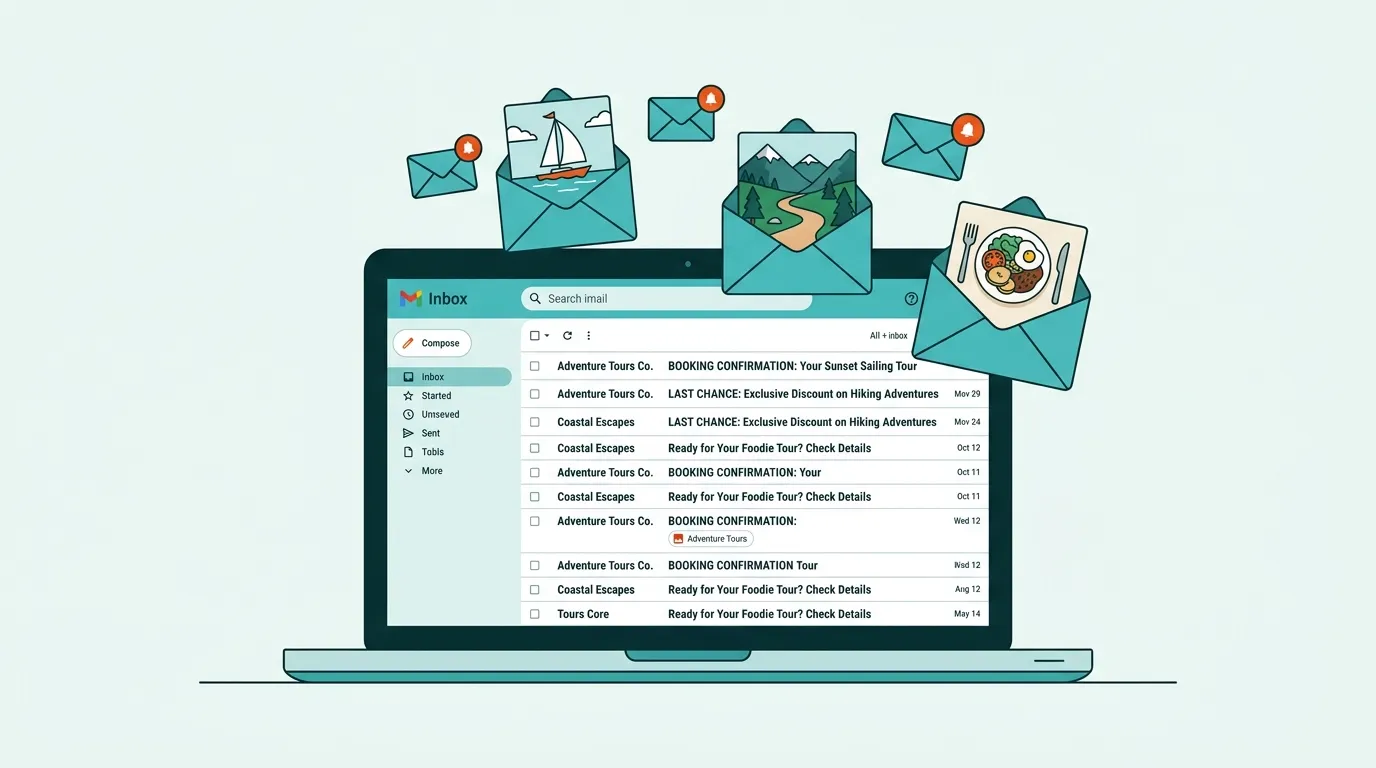
Tourism email marketing is the practice of using email to attract, engage, and convert travelers into paying customers for tours and activities. It includes everything from building a subscriber list of potential guests to sending targeted campaigns that drive bookings — welcome sequences, seasonal promotions, pre-trip logistics, post-experience follow-ups, and re-engagement campaigns for past customers.
And it’s the most underrated channel in the tour industry.
I’ve spent 15 years in marketing, built and run a tour business, and worked with operators across every niche. The pattern is always the same: operators pour money into Google Ads, obsess over Instagram, and completely ignore the channel that delivers $36 for every $1 spent.
That channel is email. And in this guide, I’m going to show you exactly how to use it.
Why Email Is the Best Marketing Channel Most Tour Operators Ignore
Let me give you the numbers first, then the logic.
The Data & Marketing Association reports an average email marketing ROI of $36 for every $1 spent. For context, paid search averages $2 for every $1 spent. Social media ads average $2.80. Email isn’t just better — it’s in a completely different category.
Here’s why it works so well for tour and activity operators specifically:
You own the relationship. Your Instagram followers belong to Instagram. Your Google rankings belong to Google. Your OTA customers belong to the OTA. But your email list? That’s yours. No algorithm change, no policy update, no platform shift can take it away from you.
Your customers are primed to buy again. Someone who booked a sunset kayak tour with you isn’t a cold lead — they already trust you. They already know what you deliver. A well-timed email turns a one-time guest into a repeat customer at near-zero acquisition cost.
The math compounds. Every email address you collect is an asset that keeps paying dividends. A list of 2,000 subscribers isn’t just a number — it’s 2,000 people you can reach for free, anytime, with a message that lands directly in their inbox. No bidding. No boosting. No praying the algorithm shows it to someone.
Most operators I talk to have email lists they’ve never used, or they send one blast a year around the holidays and wonder why it doesn’t work. That’s like having a Ferrari in the garage and complaining about your commute.
If you’re working on your broader digital marketing strategy, email should be near the top of the priority list — right behind getting your website and SEO fundamentals in place.
Building Your Email List: 5 Tactics That Actually Work for Tour Operators
Before you can send emails that fill tours, you need people to send them to. Here are five tactics that work specifically for experience-based businesses.
1. Add an Opt-In During the Booking Flow
This is the lowest-hanging fruit, and most operators miss it. When someone books a tour, add a simple checkbox: “Send me trip tips and exclusive offers.” That’s it.
You already have their email from the booking. You just need permission to market to them. Conversion rates on booking-flow opt-ins run 60-80% because the customer is already in a transactional mindset. They just gave you their credit card — checking a box feels trivial.
2. Create a Downloadable Destination Guide
Write a one-page PDF: “The Insider’s Guide to [Your Destination]” or “What to Pack for Your [Activity] Adventure.” Gate it behind an email opt-in on your website.
This works because it provides immediate value and positions you as the local expert. A snorkeling operator in Maui offering a “Maui Snorkeling Checklist: What the Guidebooks Don’t Tell You” is going to capture emails from people who are actively planning a trip — exactly the audience you want.
3. Post-Experience Signup
At the end of every tour, your guides should mention: “We send out a monthly email with insider tips, local events, and special deals for past guests. Can I add you?” This personal touch converts at a higher rate than any website form because the guest just had an incredible experience and feels connected to your brand.
Give guides a simple way to collect these — a tablet at the checkout point, a QR code on a card, or even a text-to-join number.
4. Run a Seasonal Giveaway
“Win a Free [Your Most Popular Tour] — Enter with Your Email” is a classic lead magnet for a reason. Run it during your shoulder season when you need to fill capacity. Promote it on social media, on your website, and through local partnerships.
A well-run giveaway can add 300-500 emails to your list in a week. The key: make the prize relevant to your business. Don’t give away an iPad — give away your experience. That way, everyone who enters is someone who actually wants what you sell.
5. Create Gated Destination Content
Write a comprehensive blog post — something like “The Complete Guide to [Destination] in [Season]” — and put a content upgrade in the middle of it: “Download the full itinerary as a printable PDF.”
This works because the reader is already engaged with your content. They’ve demonstrated intent. The upgrade is a natural next step, not an interruption. Operators who pair evergreen content with email opt-ins build lists that grow on autopilot.
One rule above all: never buy an email list. Purchased lists are full of dead addresses, spam traps, and people who never asked to hear from you. They’ll destroy your sender reputation, tank your deliverability, and potentially get you blacklisted by email providers. Build your list the honest way — it’s slower, but every subscriber is worth 100x more.
The 5 Emails Every Tour Operator Should Send
You don’t need a 47-email nurture sequence. You need five emails that do specific jobs. Here they are, in order of impact.
1. The Welcome Email
When to send: Immediately after someone joins your list.
What it does: Sets expectations and delivers immediate value.
This is your first impression. Don’t waste it with “Thanks for subscribing!” and nothing else. Instead:
- Tell them who you are and what makes your tours different (two sentences, max)
- Deliver the lead magnet they signed up for
- Give them one piece of genuinely useful advice about your destination
- Tell them what to expect from your emails (frequency, content type)
Subject line example: “Your Maui snorkeling guide is here (plus a local secret)”
Welcome emails get 4x the open rate and 5x the click rate of regular campaigns. Make this one count.
2. The Pre-Trip Email
When to send: 48-72 hours before their booked experience.
What it does: Reduces no-shows, builds anticipation, and upsells.
This email is operational and marketing at the same time. Include:
- What to bring and what to wear
- Meeting point details with a map link
- Weather forecast for the day
- A soft upsell: “Want to upgrade to a private tour? Reply to this email.”
- A reminder to bring a friend (with a booking link)
Pre-trip emails cut no-show rates by 15-25%. They also open the door for add-on revenue. A customer who’s excited about tomorrow’s tour is much more receptive to “Add sunset drinks on the boat for $30/person” than a cold prospect on your website.
3. The Post-Trip Review Request
When to send: 24-48 hours after the experience.
What it does: Captures reviews when the memory is fresh.
Timing is everything. Send this too soon and they haven’t processed the experience. Send it too late and the magic has faded. The 24-48 hour window is the sweet spot.
Keep it simple:
- Thank them for joining the tour
- Share one photo from the tour (if you have one)
- Ask for a review with a direct link to Google or TripAdvisor
- Include a “Refer a friend” incentive (10% off their next booking for each referral)
A tour operator who automates this single email and captures even 20% more reviews will see a measurable increase in organic bookings within 3-6 months. Reviews drive SEO, drive trust, and drive bookings. This email is a revenue machine disguised as a thank-you note.
4. The Seasonal Promotion
When to send: 4-6 weeks before your peak booking season begins.
What it does: Creates urgency and fills your calendar early.
This is the one promotional email you’re allowed to make purely about selling. But even here, lead with value:
- Share what’s new this season (new tour, upgraded equipment, new route)
- Include specific dates that are filling up
- Offer an early-bird incentive with a real deadline
- Use social proof: “Last summer, 94% of our sunset tours sold out by July”
Subject line example: “Summer 2026 calendar is live — 3 dates already waitlisted”
The key is scarcity and specificity. “Book now!” is weak. “Our July 4th sunset cruise has 8 spots left” is powerful.
5. The Destination Guide
When to send: Monthly or bi-monthly to your full list.
What it does: Keeps you top-of-mind and positions you as the local authority.
This is your newsletter — but don’t call it a newsletter. Newsletters are boring. This is a destination briefing from the person who knows your area better than anyone.
Include:
- One insider tip about your destination (a hidden restaurant, a local event, a best-kept-secret beach)
- A seasonal recommendation (“March is the best month for whale watching — here’s why”)
- One piece of your content (link to a blog post, a video, a photo gallery)
- A subtle CTA that ties back to your tours
This email builds the relationship between bookings. The goal isn’t immediate conversions — it’s making sure that when they’re ready to book again, or when their friend asks “who should I book with in [your destination]?”, your name is the first one that comes to mind.
Writing Subject Lines That Get Opened
Your email is worthless if nobody opens it. The average open rate for travel and tourism emails is around 20%. Here’s how to beat that consistently.
Use specificity over cleverness. “7 Hidden Beaches Near Cancun Only Locals Know” beats “Check Out Our Latest News!” every time. Specificity signals value. Vagueness signals spam.
Include numbers. Subject lines with numbers get 15% higher open rates. “5 things to pack for your kayak tour” works harder than “What to pack for your kayak tour.”
Create urgency without being sleazy. “3 spots left on Saturday’s sunset tour” is honest urgency. “LAST CHANCE!!! DON’T MISS OUT!!!” is spam. Know the difference.
Personalize when you can. “[First name], your summer adventure starts here” outperforms generic subject lines by 26%. Most email platforms make this trivially easy.
Test everything. A/B test your subject lines on every campaign. Send version A to 20% of your list, version B to another 20%, and the winner to the remaining 60%. Over time, you’ll develop an intuition for what your specific audience responds to.
Here are subject lines I’ve seen work for tour operators:
- “Your Costa Rica packing list (from someone who’s been 200+ times)”
- “We just added a new tour — and it’s already half full”
- “The #1 mistake first-time snorkelers make”
- “Rain tomorrow? Here’s why that’s actually great news for your tour”
- “Sarah, we saved you a spot on Saturday”
Automation Sequences That Work While You Sleep
Manual email campaigns are great, but automation is where email marketing becomes truly powerful. Set these up once, and they run forever.
Abandoned Booking Sequence
If your booking platform supports it, trigger an email when someone starts a booking but doesn’t complete it. The sequence:
- 1 hour later: “Still thinking it over? Here’s what other guests said about this tour” (include a 5-star review)
- 24 hours later: “Your [tour name] reservation wasn’t completed — spots are filling up for [date]”
- 72 hours later: “Last chance: we’re holding your spot until Friday” (include a small incentive if you want to sweeten the deal)
Abandoned booking sequences recover 5-15% of lost bookings. On a $100 average booking value with 50 abandoned bookings per month, that’s $250-$750 in recovered revenue monthly — from an email you wrote once.
Post-Experience Re-engagement
After someone takes a tour, trigger a sequence designed to bring them back:
- Day 1: Post-trip thank you + review request (Email #3 from above)
- Day 7: “Your photos from [tour name] are ready” (share professional photos if you take them, or UGC from the day)
- Day 30: “Locals do it again — here’s what’s coming up next month”
- Day 90: “It’s been a while — here’s 15% off your next adventure”
This sequence keeps the relationship warm without being pushy. By day 90, you’re re-engaging a customer who might have forgotten about you entirely.
Win-Back Sequence
For subscribers who haven’t opened an email in 6+ months:
- “We miss you — here’s what’s new at [Company Name]”
- “Should we stop emailing you?” (This sounds counterintuitive, but it works. People who want to stay will open and click. People who don’t will unsubscribe, which actually improves your deliverability.)
A clean list is a healthy list. Don’t be afraid to let disengaged subscribers go.
Segmentation: Stop Sending the Same Email to Everyone
This is where most tour operators leave the biggest pile of money on the table. Sending the same email to your entire list is like running the same ad for kayak tours and wine tours to the same audience. It’s lazy, and it kills your results.
Segment by Activity Type
If you offer multiple experiences, tag subscribers based on what they’ve booked or shown interest in. A customer who booked a family-friendly snorkeling tour doesn’t want to hear about your extreme cliff-diving adventure. Send them relevant content and watch your click rates double.
Segment by Customer Stage
- Prospects (signed up but never booked): Send destination content, social proof, and introductory offers
- First-time customers (booked once): Send post-experience content and incentives to book again
- Repeat customers (booked 2+ times): Send loyalty perks, early access to new tours, and referral incentives
Segment by Season
Tag subscribers by when they typically travel. Someone who’s booked with you every July for three years should get your summer campaign in April — not your winter schedule in November.
Segment by Source
How someone joined your list tells you a lot about their intent. A subscriber who downloaded your “Maui Snorkeling Guide” is much warmer than someone who entered a random giveaway. Tailor your messaging accordingly.
Even basic segmentation — just splitting your list into “past customers” and “prospects” — can increase email revenue by 30-50%. You don’t need to get fancy. You just need to stop treating everyone the same.
Measuring What Matters
Vanity metrics will mislead you. Here are the numbers that actually indicate whether your email marketing is working.
Open Rate: Industry average for travel is ~20%. If you’re below 15%, your subject lines need work or your list quality is poor. Above 25%, you’re doing well. Above 35%, you’re excellent.
Click-Through Rate (CTR): The percentage of openers who click a link. Aim for 2.5-4% for promotional emails, 8-12% for transactional emails (pre-trip, review requests). If your CTR is below 1%, your email content isn’t compelling enough.
Booking Attribution: This is the number that matters most, and it’s the hardest to track. Use UTM parameters on every link in every email so you can see in Google Analytics exactly which emails drove which bookings. Most email platforms integrate with Google Analytics to make this straightforward.
Revenue Per Email Sent: Total email-attributed revenue divided by total emails sent. This is your north star metric. Track it monthly. A healthy tour operator email program generates $0.10-$0.50 per email sent.
List Growth Rate: Net new subscribers per month minus unsubscribes. If your list is shrinking, you have a content quality problem, a frequency problem, or both.
Unsubscribe Rate: Below 0.5% per campaign is healthy. Above 1% means you’re emailing too often, your content isn’t relevant, or you’re sending to people who didn’t actually opt in.
Tools and Platforms for Tour Operator Email Marketing
You don’t need an enterprise email platform. Here’s what works at different stages.
Just Getting Started (0-1,000 subscribers)
Mailchimp Free Plan: 500 contacts, 1,000 sends per month, basic automation. It’s enough to set up your welcome sequence and send monthly campaigns. The drag-and-drop builder is intuitive, and the free plan includes basic segmentation.
Your Booking Platform’s Built-In Email: FareHarbor, Peek, Checkfront, and most booking platforms include basic email capabilities. For pre-trip and post-trip emails, these built-in tools are often sufficient — and they integrate directly with your booking data, which makes automation easier.
Growing (1,000-10,000 subscribers)
Mailchimp Standard ($20/month): Unlocks advanced automation, A/B testing, and better segmentation. Worth the upgrade once you’re sending regular campaigns.
ConvertKit ($29/month): Better for content-driven email strategies. If your approach leans heavily on destination guides and blog content, ConvertKit’s tagging and automation system is more flexible than Mailchimp’s.
Scaling (10,000+ subscribers)
ActiveCampaign ($49/month): The best balance of power and usability for operators with complex automation needs. CRM integration, lead scoring, and advanced segmentation.
Klaviyo: If you’re running a high-volume operation with significant e-commerce-style booking flows, Klaviyo’s event-based automation is best-in-class.
The Integration Question
Whatever platform you choose, make sure it connects to your booking system and your website. Email marketing doesn’t exist in a vacuum — it’s part of your broader marketing ecosystem. Your website drives opt-ins. Your booking platform triggers automations. Your email drives repeat bookings. It all needs to work together.
If you’re running your website on a platform like Gondola, your site is already optimized to capture leads and integrate with the tools you’re using. That matters because a fast, well-structured website converts more visitors into subscribers, which feeds your entire email machine.
And if you’re using Echo Social AI to turn your reviews into social content, you’ve got another channel driving traffic back to your site — where your email opt-ins are waiting.
Start Small, Start Now
Here’s what I’d do if I were a tour operator starting email marketing from scratch today:
Week 1: Pick an email platform (Mailchimp free plan is fine). Import your existing customer emails. Set up a simple welcome email.
Week 2: Add an email opt-in to your booking flow and your website. Create a simple lead magnet (a one-page destination guide works).
Week 3: Write and schedule your first campaign — a destination guide email with one CTA to book a tour.
Week 4: Set up your post-experience automation — a review request email triggered 24 hours after the tour date.
That’s it. Four weeks, maybe 8-10 hours of total work, and you have a functioning email marketing system. Everything after that is optimization.
The operators who win at email marketing aren’t the ones with the fanciest tools or the most complex automations. They’re the ones who start, stay consistent, and treat every subscriber like a future repeat customer — because that’s exactly what they are.
Email is the one channel where you’re not renting your audience from a tech company. Build that list. Use it well. Your tours will fill themselves.
Frequently Asked Questions
Most successful tour operators send 2-4 emails per month. During peak booking season, weekly emails work well. During off-season, bi-weekly keeps you top-of-mind without annoying subscribers. The key is consistency — pick a cadence you can maintain and stick to it. Every email should offer genuine value, not just promotions.
Mailchimp and ConvertKit are popular choices for small to mid-size operators. Mailchimp has a generous free tier and easy automation. ConvertKit is better for content-driven businesses. For operators using booking platforms like FareHarbor or Peek, check what native email features they offer — sometimes the built-in tools are enough to start.
The most effective methods are: offering a downloadable trip planning guide on your website, adding an opt-in checkbox during the booking flow, collecting emails at the point of experience (post-tour signup), running seasonal giveaways, and creating destination-specific content that requires an email to access. Never buy email lists — they destroy deliverability.