Tourism Marketing Guide for Tour Operators
Tourism marketing is the strategic process of promoting tours, activities, and travel experiences to potential customers — reaching them during the discovery, research, and booking stages of their trip planning. For tour and activity operators, it encompasses everything from SEO and content creation to paid ads, social media, email campaigns, and distribution partnerships.
That’s the textbook definition. Here’s the real one.
Tourism marketing is the difference between an operator who’s fully booked three months out and one who’s refreshing their dashboard hoping for a walk-in. I’ve been on both sides. I ran a tour business. I spent money on marketing that didn’t work, and I spent money on marketing that did. After 15 years in marketing driving over $100 million in revenue for tech companies — and now running Gondola, a website builder purpose-built for tour and activity operators — I’ve seen what separates the operators who grow from the ones who stay stuck.
This guide is everything I know about marketing a tour and activity business. Not generic marketing advice repackaged for tourism. Specific, tactical, and based on what actually works in 2026.
The Tourism Marketing Landscape in 2026
The game has changed. Here’s what matters now that didn’t five years ago:
AI has reshaped how travelers discover experiences. Google’s AI Overviews, ChatGPT, and Perplexity are answering travel queries before searchers ever click a link. If your content doesn’t include clear, specific, entity-rich answers, you’re invisible to the fastest-growing discovery channel.
OTA commissions keep climbing. Viator, GetYourGuide, and Klook are spending billions on Google Ads to capture demand. Their cut? 20-30% of your revenue per booking. Every direct booking you generate is money that stays in your pocket.
Attention spans are shorter, but intent is stronger. When someone searches “best kayak tour in Kauai,” they’re not browsing — they’re buying. The operators who capture high-intent traffic win. The ones who chase vanity metrics on social media stay stuck.
Mobile dominates everything. Over 70% of tour bookings now start on a phone. If your site isn’t fast, mobile-optimized, and easy to book from, you’re losing customers to competitors who are.
The operators thriving in 2026 aren’t the ones with the biggest budgets. They’re the ones who understand the customer journey and put the right message in front of the right person at the right time.
Understanding the Customer Journey
Every booking follows a path. Most operators focus on the end of that path — the booking page — and ignore everything that comes before it. That’s like opening a shop in a back alley and wondering why nobody walks in.
Stage 1: Discovery
The traveler doesn’t know you exist yet. They’re searching “things to do in Sedona” or “best food tours in Lisbon” or asking ChatGPT for recommendations. At this stage, your job is to show up. That means ranking for informational keywords, being cited in AI answers, and appearing in OTA search results.
Stage 2: Research
They’ve found you. Now they’re comparing you against three other operators. They’re reading reviews, checking your website, looking at photos. The operators who win this stage have fast, professional websites with real customer photos, clear pricing, compelling descriptions, and social proof everywhere. This is where your website earns its keep.
Stage 3: Booking
They’ve decided to book. This stage is all about friction reduction. Every extra click, every confusing form field, every slow page load costs you bookings. Make it absurdly easy to give you money.
Stage 4: Post-Trip
The booking is done, but the marketing isn’t. This is where repeat bookings, referrals, and reviews come from. Most operators completely ignore post-trip marketing, and it’s leaving a fortune on the table.
Every marketing decision you make should map to one of these four stages. If it doesn’t, you’re wasting money.
Channel-by-Channel Breakdown
Let me walk through every channel that matters for tour and activity operators, ranked by long-term ROI.
1. SEO & Content Marketing — The Highest Long-Term ROI
If I could only invest in one marketing channel for a tour business, it would be SEO every single time.
The math is simple. A well-written blog post about “Best Things to Do in [Your City]” can rank on Google for years. That single post might drive 500 visitors per month. At a 2% conversion rate, that’s 10 bookings per month — from one piece of content you wrote once.
Multiply that by 20 blog posts and you’re looking at 200 monthly bookings from organic search at zero ongoing cost. Compare that to spending $2,000/month on Google Ads for the same traffic. Over two years, the SEO approach costs you maybe $5,000 in content creation. The ads approach costs $48,000.
What to focus on:
- Location + activity keywords: “snorkeling tours in Maui,” “sunset sailing in Santorini”
- Informational content: “Best time to visit [destination],” “What to wear on a hiking tour”
- Comparison content: “[Your tour] vs [competitor tour]” — yes, this works
- Evergreen content that drives traffic year after year
Where operators go wrong: They write about themselves instead of what travelers are actually searching for. Nobody googles your company name until they already know you. Write for the questions people are asking before they know you exist.
For a deeper dive, read our complete SEO guide for tour operators.
2. Google Ads & PPC — The Fastest Path to Bookings
SEO takes 3-6 months to compound. Google Ads starts driving bookings tomorrow.
When Google Ads makes sense:
- You’re a new operator and need immediate revenue
- You have seasonal peaks where you need to fill inventory fast
- You’ve identified high-intent keywords with strong conversion rates
- You want to test demand for a new tour before investing in SEO
What actually works:
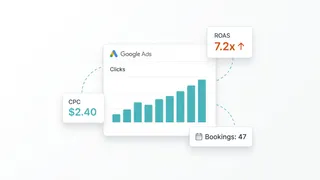
- Search ads on high-intent keywords like “book [activity] in [city]” convert at 5-10%
- Performance Max campaigns can work well for tour operators, but require at least $50/day to gather enough data
- Remarketing ads targeting people who visited your site but didn’t book — these are cheap and convert well
What wastes money:
- Bidding on broad keywords like “things to do in [city]” without negative keywords
- Running Display Network ads without remarketing audiences
- Setting and forgetting campaigns without weekly optimization
The real play: Use Google Ads to drive bookings while your SEO builds. As organic traffic grows, shift ad spend to keywords where you don’t rank yet. The two channels compound each other — more traffic means more data, more data means better optimization.
A good rule of thumb: if your cost per acquisition on Google Ads is less than 20% of your average booking value, keep spending. If it’s higher, your landing page or targeting needs work.
3. Email Marketing — The Most Underrated Channel
Tour operators consistently underinvest in email. It’s the cheapest channel per booking, and it’s the only channel where you completely control the relationship with your customer.
The numbers: Email marketing generates an average of $36 for every $1 spent across industries. For tour operators with seasonal repeat potential, the ROI is even higher.
Three email sequences every operator needs:
-
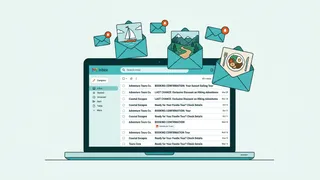
Pre-trip sequence: After booking, send 2-3 emails with trip preparation tips, what to bring, local restaurant recommendations. This reduces no-shows and builds excitement.
-
Post-trip sequence: 24 hours after the tour, ask for a review. One week later, offer a discount on their next booking or a referral incentive. This single sequence can generate 20-30% of your reviews.
-
Seasonal re-engagement: Before your peak season, email everyone who booked in the past 2 years. “We’ve added new tours this season” or “Early bird pricing for returning guests.” Past customers convert at 3-5x the rate of cold traffic.
The tool doesn’t matter. Mailchimp, ConvertKit, even a basic email list in your booking system. What matters is that you’re actually sending emails. Most operators collect thousands of email addresses and never email them once.
4. Social Media — Be Honest About What It Does
Let me save you some frustration: social media is not a reliable booking channel for most tour operators. It’s a trust-building and brand-awareness tool.
What works on social media:
- Customer-generated content: Repost photos and videos from your guests. This is the highest-engagement content you can share, and it costs nothing.
- Behind-the-scenes clips: Show your guides, your prep process, the moments between tours. Authenticity beats production quality every time.
- Short-form video on Reels and TikTok: A 30-second clip of a stunning moment on your tour can reach thousands of potential travelers organically.
What doesn’t work:
- Posting stock photos with generic captions
- Treating social media as your primary booking channel
- Spending hours on content that gets 12 likes
- Buying followers (yes, people still do this)
The real strategy: Use social media to support your other channels. When someone finds you through Google, they’ll check your Instagram. If it’s full of happy customers and beautiful moments, that reinforces their decision to book. If it’s dead or full of generic posts, it plants doubt.
Gondola’s Echo Social AI can help automate this process — turning your tour content into consistent social posts without the daily grind.
5. OTA Strategy — The Necessary Evil
Online Travel Agencies (OTAs) like Viator, GetYourGuide, and Klook will send you bookings. They’ll also take 20-30% of each one. Here’s how to use them strategically without becoming dependent.
Use OTAs for:
- Discovery — travelers who would never have found you otherwise
- Validation — listings with reviews build trust for your brand
- Filling last-minute inventory — better to sell a seat at 70% margin than leave it empty
Protect yourself by:
- Never letting OTA bookings exceed 40% of your total revenue
- Collecting email addresses from OTA customers (check your agreement — most allow post-trip contact)
- Making your direct booking experience better than the OTA experience — lower prices, exclusive add-ons, loyalty perks
- Investing in your own website so you have a direct channel that you control
An operator I worked with was paying $8,000/month in OTA commissions. We built a content strategy targeting the same keywords the OTAs were ranking for, launched a direct booking incentive (10% off + free photos), and within 8 months, their direct booking ratio went from 30% to 65%. That’s $5,000/month back in their pocket.
6. Local Marketing — The Overlooked Goldmine
Digital marketing gets all the attention, but local partnerships are quietly some of the highest-converting channels for tour operators.
What works:
- Hotel concierge partnerships: Provide commission (10-15%) to hotel front desk staff who recommend your tours. Give them business cards, a laminated one-pager, and keep the relationship warm.
- DMO (Destination Marketing Organization) partnerships: Get listed on your city or region’s official tourism website. These sites have massive domain authority and can drive significant referral traffic.
- Cross-promotion with complementary businesses: Partner with restaurants, rental shops, or other operators who serve the same travelers but aren’t competitors.
- Google Business Profile optimization: Keep your profile updated with photos, respond to every review, post weekly updates. For local searches, GBP is often more important than your website.
A real example: A walking tour operator in Charleston partnered with 12 hotels and 4 restaurants. Each partner displayed the operator’s brochures and received a 10% referral commission tracked via unique booking codes. Within a year, local referrals accounted for 25% of total bookings — at a lower cost-per-acquisition than any digital channel.
Building a Marketing Budget
The “right” marketing budget depends on your stage. Here’s a practical framework:
New Operators (Year 1-2)
Allocate 12-15% of projected revenue.
- 40% on Google Ads (immediate bookings while SEO builds)
- 30% on website and SEO (your foundation — a fast, professional site is non-negotiable)
- 15% on OTA listing optimization and fees
- 10% on email setup and local partnerships
- 5% on social media content
Growing Operators (Year 3-5)
Allocate 8-12% of revenue.
- 35% on SEO and content marketing
- 25% on Google Ads (more targeted, higher ROI keywords)
- 15% on email marketing and retention
- 15% on local partnerships and cross-promotion
- 10% on social media
Established Operators (Year 5+)
Allocate 5-8% of revenue.
- 40% on content and SEO (protecting and expanding rankings)
- 20% on email marketing and loyalty programs
- 20% on Google Ads (defending brand keywords, seasonal pushes)
- 10% on partnerships and co-marketing
- 10% on testing new channels
The golden rule: Never spend money on a channel you aren’t measuring. If you can’t tell me the cost-per-booking from your Google Ads or the revenue generated by your email campaigns, you’re guessing. And guessing gets expensive.
Seasonal Marketing Strategies
Tourism is inherently seasonal. The operators who thrive year-round treat peak season and off-season as two completely different marketing challenges.
Peak Season Strategy
Your goal during peak season isn’t more awareness — it’s conversion optimization. Travelers already want to book. Your job is to make sure they book with you.
- Increase Google Ads budgets on high-intent keywords 6-8 weeks before peak season
- Raise prices strategically — if you’re selling out regularly, your prices are too low
- Focus email campaigns on urgency: limited availability, popular dates filling fast
- Optimize your booking page — every 1-second improvement in load time increases conversions by 7%
- Collect content — peak season is when you get the best customer photos and reviews for off-season marketing
Off-Season Strategy
Off-season is when you build the foundation that makes peak season profitable.
- Double down on content creation — write the blog posts, shoot the videos, build the landing pages that will rank by next season
- Target locals — residents looking for weekend activities don’t follow tourist seasons
- Create shoulder-season packages at reduced prices to extend your revenue window
- Run remarketing campaigns to past customers with “come back” offers
- Invest in your website — rebuild, optimize, and improve when the stakes are lower
- Build local partnerships — hotel managers have more time to talk to you in January than July
A practical example: A snorkeling operator in Key West used their November-February slow period to publish 15 location-specific blog posts. By the following April, those posts were driving 2,000+ monthly visitors. They spent $3,000 on content creation and generated an estimated $45,000 in bookings from that traffic over the next 12 months.
Measuring What Works
Most operators track the wrong things. Let’s separate the metrics that matter from the vanity metrics that feel good but don’t pay the bills.
Metrics That Actually Matter
- Cost per acquisition (CPA) by channel: How much does it cost you to get one booking from Google Ads? From organic search? From email? This is the single most important metric for budget allocation.
- Direct booking ratio: What percentage of your bookings come directly through your website vs. OTAs? Higher is better. Aim for at least 50%.
- Revenue per visitor: Total revenue divided by total website visitors. This tells you how well your site converts and what a visitor is worth — critical for calculating ad spend limits.
- Customer lifetime value (CLV): Repeat customers are 5-7x cheaper to acquire than new ones. If you’re not tracking repeat booking rates, you’re undervaluing your email list.
- Review generation rate: What percentage of customers leave a review? Benchmark is 10-15%. Below 5% means your post-trip follow-up needs work.
Vanity Metrics That Don’t Pay Bills
- Social media followers: 10,000 followers with zero bookings is worse than 500 followers who actually book
- Website traffic without conversion context: 50,000 visitors means nothing if they all bounce
- Email list size without engagement: 5,000 subscribers with a 2% open rate is a dead list
- Impressions: Nobody ever paid their rent with impressions
Set up Google Analytics 4 (it’s free) and track conversions from each channel. If you use a booking system, connect it to GA4 so you can see the actual revenue from each traffic source. This single setup will change how you allocate your marketing budget.
Your Website: The Hub of Everything
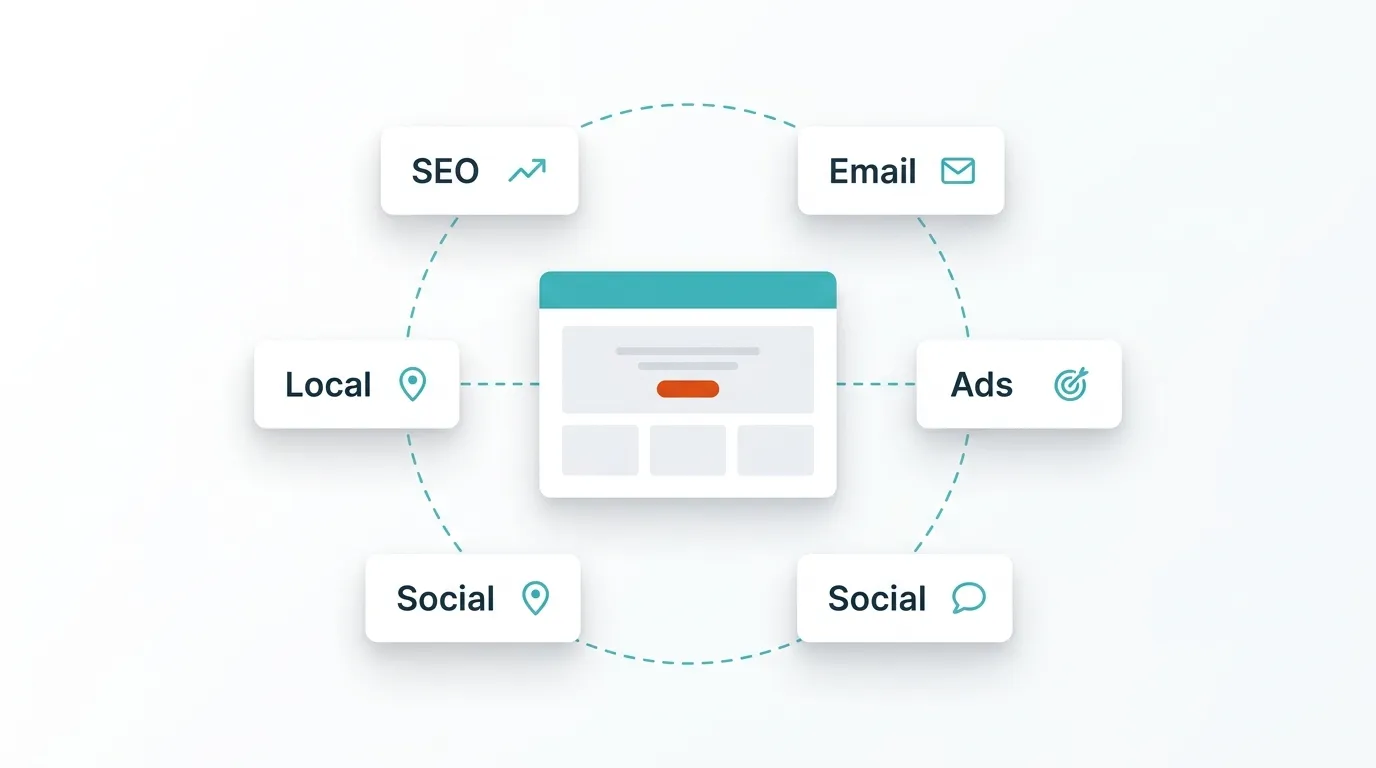
Every marketing channel drives traffic somewhere. For tour operators, that somewhere must be your website. Not your OTA listing. Not your Instagram. Your website.
Here’s why: your website is the only marketing asset where you control the experience, capture customer data, avoid commission fees, and build long-term brand equity.
What a high-converting tour operator website needs:
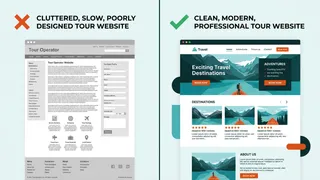
- Speed: Under 2.5 seconds load time on mobile. Anything slower and you’re losing 20%+ of visitors.
- Mobile-first design: Not mobile-friendly — mobile-first. Your site should be designed for phones and then adapted for desktop.
- Clear booking CTAs: Visitors should be able to start the booking process within one click from any page.
- Social proof: Reviews, customer photos, trust badges, and partner logos — visible above the fold.
- Location-specific landing pages: If you operate in multiple locations, each one needs its own page optimized for local search.
- Structured data markup: Schema.org markup for tours, reviews, FAQs, and pricing helps you appear in rich Google results and AI answers.
Your website isn’t a brochure. It’s a booking machine. And it’s the single highest-ROI marketing investment you can make.
With Gondola, you get a professionally built website designed specifically for tour and activity operators — fast, mobile-optimized, and built to convert. And when you want to tweak it, you can jump in and adjust anything without waiting on a developer or a support ticket.
The 90-Day Tourism Marketing Action Plan
Theory is useless without action. Here’s exactly what to do if you’re starting from scratch or resetting your tour marketing strategy:
Days 1-30: Foundation
- Set up Google Analytics 4 and Google Search Console
- Optimize your Google Business Profile (photos, description, categories)
- Audit your website speed and mobile experience
- Set up a basic email capture (pop-up or inline form offering a trip planning guide)
- Publish 2 blog posts targeting “[activity] in [your city]” keywords
Days 31-60: Acceleration
- Launch a Google Ads campaign on your top 5 high-intent keywords
- Send your first email campaign to past customers
- Contact 5 local hotels about referral partnerships
- Publish 2 more blog posts targeting informational queries
- Set up a post-trip review request email sequence
Days 61-90: Optimization
- Review Google Ads performance — kill what’s not working, scale what is
- Analyze which blog posts are gaining traction in Search Console
- Expand local partnerships based on what’s converting
- Set up remarketing ads for website visitors who didn’t book
- Plan your content calendar for the next quarter around seasonal keywords and evergreen topics
The Bottom Line
Tourism marketing isn’t complicated. But it does require focus, consistency, and a willingness to measure what’s working instead of guessing.
The operators I’ve seen grow fastest all share the same traits: they invest in SEO early, they build an email list from day one, they treat their website as their most important asset, and they make decisions based on data — not gut feeling.
You don’t need to do everything on this list. Start with the channels that match your stage, measure aggressively, and double down on what’s working.
The best time to start was last year. The second best time is today.
For a more detailed look at digital marketing channels and tactics, check out our complete digital marketing guide for tour operators.
Frequently Asked Questions
Tourism marketing is the process of promoting travel-related experiences — tours, activities, attractions, and destinations — to potential customers through channels like SEO, paid ads, social media, email, and partnerships. For tour and activity operators, effective tourism marketing focuses on reaching travelers during the discovery and research phases of their trip planning, then converting that interest into direct bookings.
Most successful tour operators allocate 7-12% of gross revenue to marketing. New operators may need to invest closer to 15% to build initial awareness, while established businesses with strong organic traffic can maintain growth at 5-8%. The key is tracking cost-per-acquisition by channel and shifting budget toward what's actually producing bookings.
SEO and content marketing deliver the highest long-term ROI for tour operators because they compound over time. A single well-optimized blog post can drive bookings for years at zero ongoing cost. Google Ads is the fastest channel for immediate results. Email marketing is the most underrated — it's the cheapest way to drive repeat bookings. The most successful operators combine 2-3 channels rather than relying on one.
Successful off-season strategies include creating shoulder-season packages at reduced prices, targeting local residents instead of tourists, running Google Ads on 'things to do in [city] in winter' queries, building email sequences for past customers, partnering with local hotels for bundled experiences, and publishing content that highlights the unique appeal of visiting during quieter months.