Travel Website SEO for Tour Operators
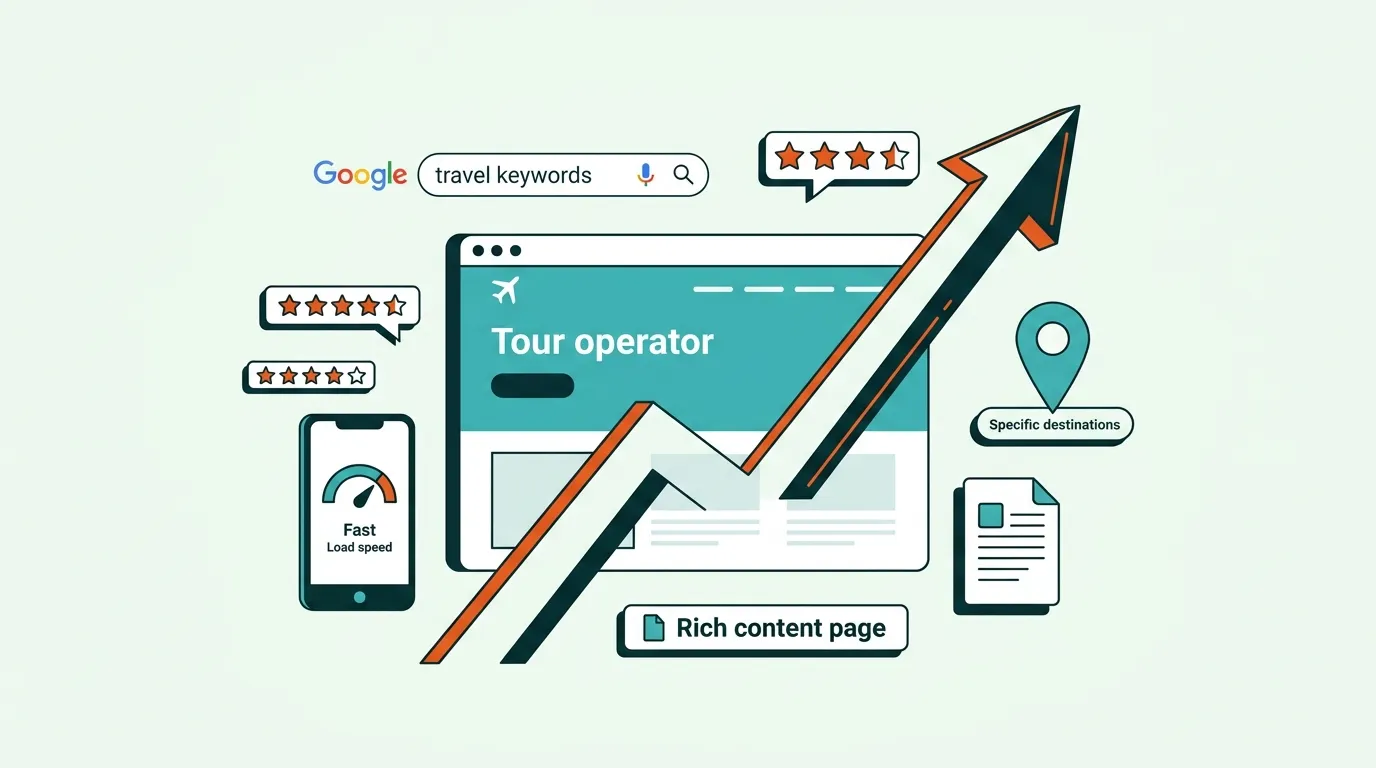
Travel website SEO is the practice of optimizing a tourism or tour operator website to rank higher in search engines for queries travelers use when planning trips, researching destinations, and booking experiences. For tour and activity operators, SEO is the highest-ROI marketing channel available — it captures high-intent searchers at the exact moment they’re deciding what to do and who to book with.
I’ve spent 15+ years in marketing, ran a tour business, and now run Gondola — a website builder purpose-built for tour and activity operators. I’ve seen hundreds of operator websites. Most of them are leaving thousands of dollars in bookings on the table because of fixable SEO mistakes. This guide covers everything: the technical foundations, the content strategy, the local SEO playbook, and the AI optimization that 99% of operators haven’t even started thinking about.
Why SEO Matters More for Tour Operators Than Almost Any Other Business
Tour operators exist in a uniquely SEO-friendly market. Three characteristics make organic search disproportionately valuable for this industry:
High-intent searches dominate. When someone searches “snorkeling tours in Maui,” they’re not browsing — they’re booking. Google data shows that travel-related “near me” searches have grown 150% over the past five years. Every one of those searches represents a potential booking, and operators who rank for them capture revenue that would otherwise go to OTAs taking 20-30% commission.
Seasonality creates compounding opportunities. A blog post about “best winter activities in Park City” published in September starts ranking by November, drives traffic through March, and then does it all over again next year. Paid ads disappear the moment you stop paying. SEO content compounds. I’ve seen a single evergreen blog post generate $40,000+ in attributable bookings over three years.
Local competition is weak. Most tour operators are small businesses running WordPress sites they haven’t touched since 2019. They don’t have schema markup. Their pages load in 6+ seconds. Their only content is tour descriptions. If you execute even basic SEO, you’ll outrank 80% of your local competitors within six months.
The Travel SEO Flywheel
Before diving into tactics, understand the mechanism. Travel website SEO works as a flywheel with four components:
- Technical foundation ensures search engines can crawl, index, and understand your site
- Content captures travelers during the research and planning phase
- Local signals establish your authority in your specific geography
- Backlinks and authority compound over time as other sites reference your content
Each component reinforces the others. Great content earns backlinks. Backlinks increase domain authority. Higher authority makes new content rank faster. Faster rankings mean more traffic, which generates more reviews and social proof, which strengthens local signals. The flywheel accelerates.
Most operators try to skip to content without fixing their technical foundation, or they fix technical issues without producing content. Both approaches stall. You need all four components working together.
Technical SEO for Travel Websites: The Foundation
Technical SEO isn’t glamorous, but it’s non-negotiable. A travel website with broken technical foundations is like a tour boat with a hole in the hull — nothing else matters until you fix it.
Page Speed
Google has explicitly confirmed that page speed is a ranking factor. For travel websites, speed matters even more because travelers are often searching on mobile with spotty connections — think hotel WiFi, airport terminals, or cellular data in rural destinations.
The benchmarks that matter:
- Largest Contentful Paint (LCP): under 2.5 seconds
- Cumulative Layout Shift (CLS): under 0.1
- Interaction to Next Paint (INP): under 200ms
- Overall PageSpeed Insights score: 80+ on mobile
Run your site through PageSpeed Insights right now. If your mobile score is under 50, you’re actively losing rankings. The most common culprits for slow travel sites: uncompressed hero images (that beautiful 4MB sunset photo is killing you), unoptimized JavaScript from booking widgets, and cheap shared hosting.
Mobile-First Design
Over 60% of travel searches happen on mobile devices. Google uses mobile-first indexing, meaning it evaluates the mobile version of your site for ranking purposes. If your site looks great on desktop but is a mess on mobile, Google sees the mess.
Check for: text that’s readable without zooming, buttons large enough to tap (minimum 48x48 pixels), no horizontal scrolling, booking widgets that work on small screens.
Schema Markup
Schema markup is structured data that tells search engines exactly what your content represents. For tour operators, proper schema is a massive competitive advantage because almost nobody in the industry implements it correctly.
Essential schema types for tour websites:
- TourOperator or LocalBusiness: Your company details, operating hours, service area
- Product or TourTrip: Individual tour listings with pricing, duration, availability
- Review/AggregateRating: Star ratings that appear directly in search results
- FAQ: Question-and-answer pairs that can appear as rich results
- BreadcrumbList: Navigation path that helps Google understand site structure
A tour page with Product schema showing “$89 per person,” “4.8 stars from 230 reviews,” and “Available daily” in the search results will massively outperform a plain blue link. Rich results increase click-through rates by 20-30% according to multiple studies.
If you’re on a platform like Gondola, schema markup is built in automatically — every tour page, every review, every FAQ gets proper structured data without you touching a line of code.
Core Web Vitals and Crawlability
Beyond speed and schema, make sure these basics are covered:
- XML sitemap submitted to Google Search Console (and updated automatically when you add pages)
- Robots.txt that doesn’t accidentally block important pages
- Clean URL structure:
/tours/sunset-sailing-charlestonbeats/page?id=4837 - HTTPS everywhere — no mixed content warnings
- No duplicate content — canonical tags on similar tour pages
- Proper heading hierarchy — one H1 per page, logical H2/H3 structure
Content Strategy: How Tour Operators Win at SEO
Technical SEO gets you into the game. Content wins it. The operators who dominate organic search aren’t the ones with the prettiest websites — they’re the ones publishing useful content consistently.
The Three Content Tiers
Tier 1: Tour and Product Pages (Bottom of Funnel)
These pages target people ready to book: “sunset sailing tour Charleston,” “Maui snorkeling tour,” “Central Park bike tour.” Every tour you offer needs a dedicated, optimized page with:
- A keyword-rich title tag (primary keyword + location + compelling modifier)
- 400+ words of unique description (not copy-pasted from your OTA listing)
- Pricing, duration, what’s included, what to bring
- High-quality photos with descriptive alt text
- Customer reviews embedded on the page
- Clear call-to-action with booking widget
Tier 2: Destination and Activity Guides (Middle of Funnel)
This is where most operators leave the biggest gap. Travelers planning trips search for content like:
- “Things to do in [city] this weekend”
- “Best [season] activities in [destination]”
- “[City] travel guide”
- “What to wear kayaking”
- “[Destination] itinerary for 3 days”
These queries have massive search volume — often 10-50x more than specific tour keywords. A guide about “Best Things to Do in Key West” might get 8,000 searches per month, while “Key West boat tour” gets 800. The destination guide captures travelers early, builds trust, and funnels them to your tour pages through internal links.
For a deeper look at this strategy, read our full guide on evergreen content for tour and activity operators.
Tier 3: Educational and Planning Content (Top of Funnel)
These posts answer questions travelers ask before they’ve even chosen a destination:
- “Best islands for snorkeling in the US”
- “Family-friendly adventure vacations”
- “How to plan a destination bachelorette party”
Top-of-funnel content has the highest volume and the longest conversion path, but it builds topical authority that makes your Tier 1 and Tier 2 content rank better. Google rewards sites that demonstrate comprehensive expertise on a topic — publishing across all three tiers signals that expertise.
The Publishing Cadence That Works
You don’t need to publish daily. You need to publish consistently. For most tour operators, one well-researched, 1,500-2,000 word blog post per month is enough to see meaningful SEO growth within six months. Two posts per month accelerates the timeline significantly.
Quality beats quantity every time. One comprehensive guide that becomes the definitive resource for “things to do in [your city] with kids” is worth more than 20 thin posts nobody reads.
If writing isn’t your strength or you simply don’t have the time, our Evergreen Traffic Machine service handles the entire content pipeline — keyword research, writing, optimization, and publishing — starting at $349/month.
Local SEO: The Tour Operator’s Secret Weapon
Tour operators are inherently local businesses, which means local SEO is arguably your highest-leverage activity. When someone searches “boat tours near me” or “walking tours in Savannah,” Google serves local results — and the operators who’ve optimized for local search dominate the Map Pack (those three business listings that appear above organic results).
Google Business Profile Optimization
Your Google Business Profile (GBP) is your most important digital asset after your website. Treat it that way.
Complete every field. Business name, address, phone, website, hours, service area, business description, attributes — all of it. Google rewards complete profiles with higher visibility.
Choose the right categories. Your primary category should be as specific as possible (e.g., “Boat Tour Agency” rather than “Tour Agency”). Add secondary categories for every relevant service.
Post regularly. Google Posts — those mini-updates that appear on your profile — signal an active business. Post at least weekly: upcoming tours, seasonal highlights, customer photos, special offers.
Add photos constantly. Businesses with 100+ photos get 520% more calls than the average business (Google’s own data). Upload photos of tours in action, your vessels/equipment, your team, and the locations you visit. Geotagged photos are even better.
Review Management
Reviews are the single strongest local ranking factor. More reviews with higher ratings equals higher visibility in local results. This isn’t speculation — it’s the finding of every local SEO study published in the last five years.
The system that works:
- Ask for reviews immediately after the tour experience (within 24 hours)
- Make it frictionless — send a direct link to your Google review page via text or email
- Respond to every review, positive and negative, within 48 hours
- Never incentivize reviews with discounts — Google’s policies prohibit this and they’re getting better at detecting it
A tour operator with 200 five-star reviews will outrank a competitor with 15 reviews in local results almost every time, assuming other factors are roughly equal.
Local Citations and Directories
Ensure your business name, address, and phone number (NAP) are identical everywhere they appear online:
- Google Business Profile
- Yelp
- TripAdvisor
- Local Chamber of Commerce
- Tourism board / DMO website
- Apple Maps
- Bing Places
- Industry-specific directories (e.g., TourScanner, Viator)
Inconsistent NAP data confuses search engines and hurts local rankings. If your business is “Coastal Kayak Adventures LLC” on Google but “Coastal Kayak Adventures” on Yelp and “Coastal Kayaking Adventures” on TripAdvisor, you’re diluting your local authority.
Link Building for Tour Operator Websites
Backlinks — links from other websites to yours — remain one of the top three ranking factors in Google’s algorithm. For travel websites, link building is less about outreach campaigns and more about leveraging relationships you already have.
DMO and Tourism Board Partnerships
Your local Destination Marketing Organization (DMO) or tourism board almost certainly has a website with high domain authority (often DR 50-80). Most DMOs maintain operator directories. If you’re not listed, email them today — this is often the easiest high-quality backlink you’ll ever get.
Go further: offer to write a guest article about your activity niche for their blog. DMOs need content, and you’re the expert. A guide about “Top Water Activities in [Destination]” published on the tourism board’s website sends both a powerful backlink and qualified referral traffic.
Travel Blogger Outreach
Invite travel bloggers and content creators to experience your tours. Not in exchange for a guaranteed positive review — that’s ethically questionable and Google discounts paid/incentivized links anyway. Invite them because a genuine experience produces genuine content that links back to your site naturally.
Focus on bloggers who actually write about your destination or activity niche. A kayaking blogger with 5,000 monthly readers who writes about your kayak tour is worth more than a generic travel blogger with 50,000 readers who mentions you in a listicle.
Local Business Cross-Promotion
Hotels, restaurants, and other tourism businesses in your area are natural link partners. Offer to feature them in your destination guides in exchange for a mention on their “things to do” page. These reciprocal relationships are natural to the tourism industry and Google doesn’t penalize them when they’re genuine.
Digital PR Through Data and Stories
The strongest link building for tour operators comes from creating content that journalists and bloggers want to reference. Annual reports like “Peak Season Booking Trends for [Destination]” or unique data from your own operations (“We surveyed 1,000 of our customers — here’s when they book and how far in advance”) generate press coverage and high-authority backlinks.
Common SEO Mistakes Tour Operators Make
After reviewing hundreds of tour operator websites, these are the mistakes I see over and over. If you recognize your site in this list, fix the underlying issue before investing in content or link building.
Relying on OTA content instead of creating your own. If your tour descriptions on your website are identical to your Viator or GetYourGuide listings, you have a duplicate content problem. Google won’t rank the same text twice. Write unique descriptions for your own site — and make them better than the OTA version.
Ignoring page speed because “the site looks fine to me.” Your site might load fast on your office WiFi. Test it on a mobile device with throttled connection. Run PageSpeed Insights. The number doesn’t lie.
No content strategy beyond tour pages. Tour pages alone can’t compete with operators who publish destination guides, seasonal content, and planning resources. You need content that captures travelers before they’re ready to book.
Skipping schema markup entirely. I estimate that fewer than 10% of tour operator websites have proper schema markup. Those that do get rich results — star ratings, pricing, availability — that dramatically increase click-through rates from search results.
Treating SEO as a one-time project. SEO is not a website redesign. It’s an ongoing practice. Publish content regularly, monitor rankings, update old content, build links continuously. The operators who treat SEO as a habit outperform those who treat it as a project every single time.
Buying cheap backlinks. Those emails offering “500 backlinks for $99”? Those links come from spam sites and can trigger a Google penalty that takes months to recover from. One quality link from your local DMO is worth more than 500 links from random directories.
How to Measure Travel SEO Success
SEO without measurement is guessing. Here are the KPIs that actually matter for tour operator websites, and the tools to track them.
The Metrics That Matter
| Metric | Tool | Why It Matters |
|---|---|---|
| Organic traffic | Google Analytics (GA4) | Total visitors from search engines |
| Keyword rankings | Google Search Console / Ahrefs | Position for target keywords |
| Organic conversions | GA4 with conversion tracking | Bookings attributable to organic search |
| Click-through rate | Google Search Console | % of impressions that become clicks |
| Core Web Vitals | PageSpeed Insights | Technical health indicators |
| Local Pack visibility | GBP Insights | Impressions and actions from local search |
| Backlink growth | Ahrefs / Moz | New referring domains over time |
The Free Stack
You can measure everything that matters with free tools:
- Google Search Console: Your most important SEO tool. Shows which queries drive impressions and clicks, which pages rank, technical issues, and indexing status.
- Google Analytics 4: Traffic sources, user behavior, conversion tracking. Connect it to Search Console for a complete picture.
- Google Business Profile Insights: How people find and interact with your local listing.
- PageSpeed Insights: Core Web Vitals and performance scores.
Check Search Console weekly. Review GA4 monthly. Run PageSpeed Insights after any site changes. That’s the minimum measurement cadence.
What “Good” Looks Like
Benchmarks vary by market size and competition, but for a tour operator executing a consistent SEO strategy:
- Month 3: Noticeable increase in impressions and indexed keywords in Search Console
- Month 6: 20-50% increase in organic traffic; several blog posts ranking on page 1-2
- Month 12: Organic traffic becomes a top-3 booking channel; 100+ keywords ranking on page 1
- Month 24: Organic search drives 30-50% of total bookings; content library generates compounding returns
Optimize for AI Search: The Next Frontier
Here’s where tourism SEO is heading, and almost nobody in the industry is prepared for it.
When a traveler asks ChatGPT “what are the best boat tours in Miami?”, asks Perplexity “recommend a food tour in New Orleans,” or gets a Google AI Overview for “best kayak tours near me” — your website is either part of the answer or it isn’t. There’s no page 2 in AI search. You’re either cited or invisible.
AI search engines pull answers from websites with three characteristics: structured data they can parse, comprehensive content that demonstrates expertise, and established authority signals (backlinks, reviews, citations).
What to do now:
- Implement comprehensive schema markup across every page. AI models use structured data to understand what your business offers, where you operate, and what makes you different.
- Create a dedicated LLM-readable page. At Gondola, we build an “LLM Start Here” page into every site we create — it’s a structured summary of the business designed specifically for AI models to ingest. Think of it as your business’s resume for AI search engines.
- Build topical authority through content depth. AI models don’t just look at one page — they evaluate whether your entire site demonstrates expertise on a topic. A tour operator with 30 pieces of destination content is far more likely to be cited than one with just tour listings.
- Maintain accurate, consistent business information everywhere. AI models cross-reference multiple sources. If your hours, pricing, or tour offerings are inconsistent across your website, Google Business Profile, and OTA listings, AI models lose confidence in citing you.
This is a land-grab moment. The operators who optimize for AI search in 2026 will have a structural advantage for years as AI-powered discovery becomes the norm.
Bringing It All Together
Travel website SEO isn’t one tactic — it’s a system. Technical foundations make your site crawlable and fast. Content captures travelers at every stage of the planning journey. Local SEO dominates the Map Pack. Backlinks compound your authority. AI optimization positions you for the future.
Here’s the priority order for a tour operator starting from scratch:
- Fix technical foundations — speed, mobile, schema, Search Console (Week 1-2)
- Optimize existing tour pages — unique descriptions, proper titles, embedded reviews (Week 3-4)
- Claim and optimize Google Business Profile — complete every field, start requesting reviews (Week 1, ongoing)
- Publish first destination guide — target your highest-volume local keyword (Month 1)
- Build citation consistency — audit NAP across all directories (Month 2)
- Establish a content cadence — one quality post per month minimum (Ongoing)
- Pursue DMO and local backlinks — reach out to tourism boards and partners (Month 2-3)
- Implement AI optimization — structured data review, LLM-readable content (Month 3-4)
If you want a platform that handles steps 1 and 3 automatically and makes step 6 dramatically easier, see what Gondola does for tour operators. We built the technical SEO infrastructure so operators can focus on running tours instead of debugging WordPress plugins.
For a broader view of how SEO fits into your overall marketing strategy, read our digital marketing guide for tour operators. And if you want to understand SEO fundamentals in more depth, our SEO for tour operators guide covers the building blocks.
The operators who win at SEO aren’t the ones with the biggest budgets. They’re the ones who start, stay consistent, and let the flywheel do its work.
Frequently Asked Questions
Most travel and tourism websites start seeing measurable organic traffic increases within 3-6 months of consistent effort. Technical fixes (page speed, mobile optimization, schema markup) can show results in weeks. Content-driven SEO takes longer but compounds — a single well-optimized destination guide can drive traffic for 3-5 years. The key variable is competition: ranking for 'boat tours in Key West' is faster than ranking for 'things to do in New York City.'
The highest-ROI SEO strategy for tour operators combines three elements: technical SEO (fast site, mobile-first, proper schema markup), destination content (evergreen guides targeting planning-phase keywords like 'things to do in [city]'), and local SEO (optimized Google Business Profile, consistent citations, active review management). Most operators over-invest in social media and under-invest in content — flipping that ratio is the single biggest lever.
DIY SEO costs nothing but time — Google Search Console, Google Business Profile, and content publishing are free. Professional SEO services for tour operators typically range from $500-$2,000/month for content creation and optimization. A purpose-built platform like Gondola handles technical SEO automatically (schema markup, page speed, sitemaps), which eliminates the $1,000-$3,000 most operators spend on WordPress SEO plugins and developer fixes.
A blog is the single most effective SEO tool for tour operators. Tour and activity pages target bottom-of-funnel keywords (people ready to book), but blog content captures the far larger pool of travelers in the planning phase — searching for 'best things to do in [destination]' or 'what to wear kayaking.' One operator we work with generates 60% of their organic traffic from blog content, which then funnels into tour page bookings.