AI is giving DMOs & CVBs a bigger role in consumer discovery and planning
A tour operator recently told me he was cutting back on DMO memberships. For years, joining the local tourism board had been part of his plan each time he opened in a new city. Now he was looking at the bookings those sites sent him and asking whether the fees still made sense.
I think that is a fair question. A business needs customers, and a report full of AI mentions does not pay the bills. But as we looked through his report together, the tourism sites kept turning up as sources. They were helping AI describe the places where he ran tours. His business was often missing from those broad answers.
What stayed with me was the gap between what the operator could measure and what we could see in the answers. He was counting bookings from the DMO’s site. AI was using that same site to help people decide what to do.
A traveler can now get advice drawn from your website without ever opening it. An AI assistant can use your guides to suggest a neighborhood, build a day around a local attraction, or explain which experiences suit a family. The traveler may then search for an operator by name or follow a booking link elsewhere. Your site helped inform the plan, but that path may never show up as a referral from you.
We cannot tell from a citation whether anyone booked a tour. But we can see which businesses AI includes in its travel advice and where that advice comes from. DMOs are already helping shape those recommendations. Their responsibility to describe local businesses accurately now extends to the travelers getting that information through AI.
Your website is already part of the answer
In our September activity research, ChatGPT cited an official tourism site in 72% of broad discovery answers. Across the same 21 selected assessments, an official tourism domain ranked first or tied for first among cited domains in 16. We asked what to do in a place, before naming any business.
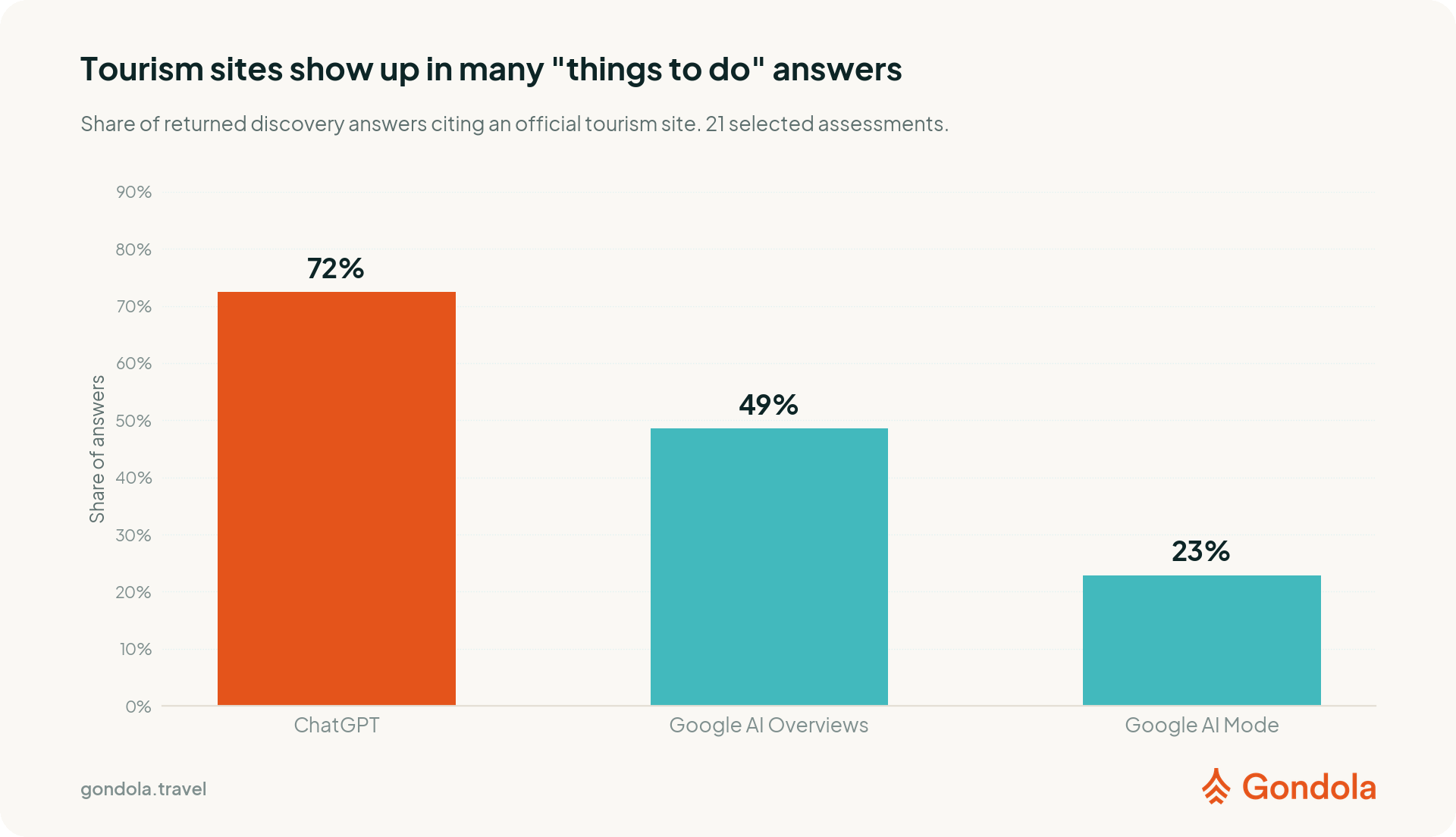
The assessments include some overlapping destinations. Rates count returned answers with a tourism-site citation.
One saved answer makes this easy to see. We asked, “What is there to do in Morgan Hill, California?” ChatGPT suggested downtown shops, wineries, parks, farms, and events, then put together a one-day plan. Every source it listed came from Visit Morgan Hill. Five tourism pages helped supply the answer, including the winery page, parks page, and destination guide.
That is a lot of influence for a DMO to carry. Its work had become the basis for advice from another service. Someone reading that answer did not have to know Visit Morgan Hill existed to benefit from its work.
For a tour business, this moment matters. Someone has to decide that a food tour, a sailing trip, or a guided hike belongs in their visit before they start comparing companies. A DMO can help put that choice on the table. It can also explain how it fits with the rest of the day: where to stay, how to get there, what is nearby, and what is open that season.
A tour company can describe its own trip in depth. A DMO can connect it to the wider visit. It knows local businesses and has a reason to care about the place as a whole. That helps someone who needs to make several choices at once.
You can see this role in the sources today. A DMO does not need to launch a chatbot or wait for a future booking agent to take part. AI systems are already using the guides and pages you publish.
Being in the directory is only part of it
Once you start looking at those answers with operators, the next question comes quickly: we are members, and we have a listing, so why aren’t we showing up?
The calls have brought this home for me. On one, a dive operator pointed out that her tourism listing had the wrong address and described snorkeling without explaining the diving she offered. Her report showed AI citing tourism pages about underwater sights and things to do. She was already working to get her listing corrected. Seeing how often AI used the tourism site gave her another reason to act.
A listing error is a problem for anyone reading the page. If AI uses the page to build travel advice, the error can spread beyond the site. We did not prove that this error changed an AI answer. But it shows why the details matter to a local business.
There is also a difference between having a page somewhere on the site and being described on the pages AI actually cites. In our saved assessments, 49% of 751 tourism-page citations went to guides and roundups. Only 7% went to individual business listings.
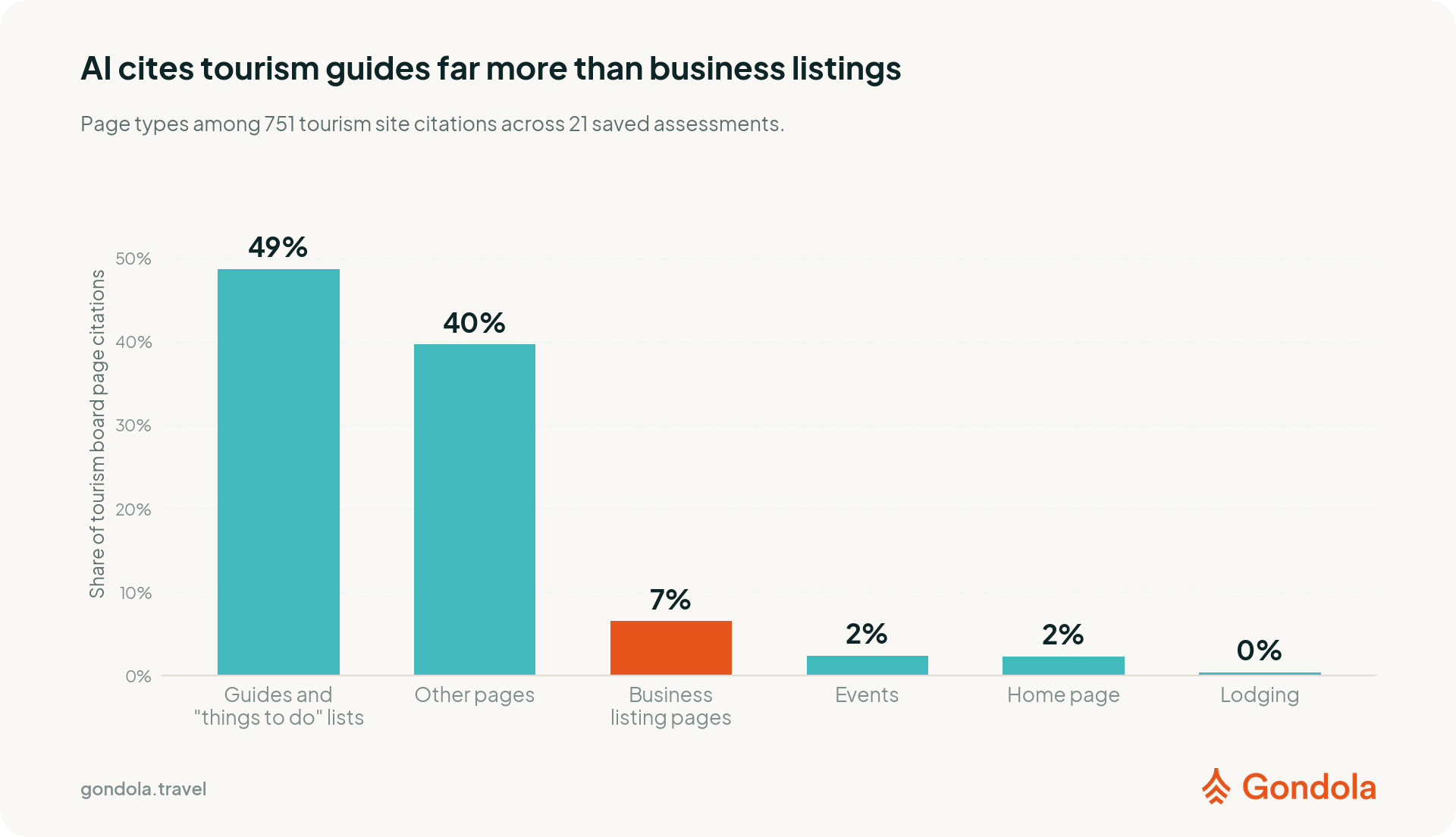
Page types were estimated from URLs across the saved assessments.
Of course guides get cited. They answer the broad questions people ask. But a guide can only feature so many businesses. If the rest have a name, a photo, and two vague sentences in the directory, there is very little there to help someone choose them.
That weakness becomes clearer as the questions get specific. In our ChatGPT results, tourism-site citations fell from 72% for broad discovery to 30% for a specific kind of activity and 23% for a traveler’s particular needs. Those are separate question groups, but the difference is worth a close look.
A visitor choosing a boat tour may need to know the minimum age, where it leaves, how long it takes, whether there are stairs, and what happens if the weather turns. “Family friendly” is a nice phrase. It does not answer any of that. Those details can be the reason a small operator is the right choice, even if it has never appeared in a “best things to do” article.
This is where the DMO’s influence becomes a duty to local businesses. What you publish helps shape what people can learn about them. A thin record can leave a good business hard to assess. Rich detail about just a few names can make the place look smaller than it is.
I understand the pressures around members, sponsors, and board priorities. But a DMO has a public or shared mission. It can serve businesses that cannot afford a large marketing team, as well as those that can. If AI draws on its account of the place, that account should give people a fair chance to be found.
Hotels should get your attention, too
Tours and activities are the heart of this for me. They are the businesses we work with at Gondola, and they are the reason I started looking closely at these sources. But I know many DMO leaders watch hotel demand most closely. We ran a separate hotel study to see whether the same issue reached that part of the destination.
When we directly asked AI systems for an official destination hotel list, 65 of 68 answers named or linked to the DMO. The site was easy to identify. Yet among 317 citations to DMO pages in hotel answers, only nine led to an individual hotel listing. That is 3%. Lodging category pages accounted for 43%.
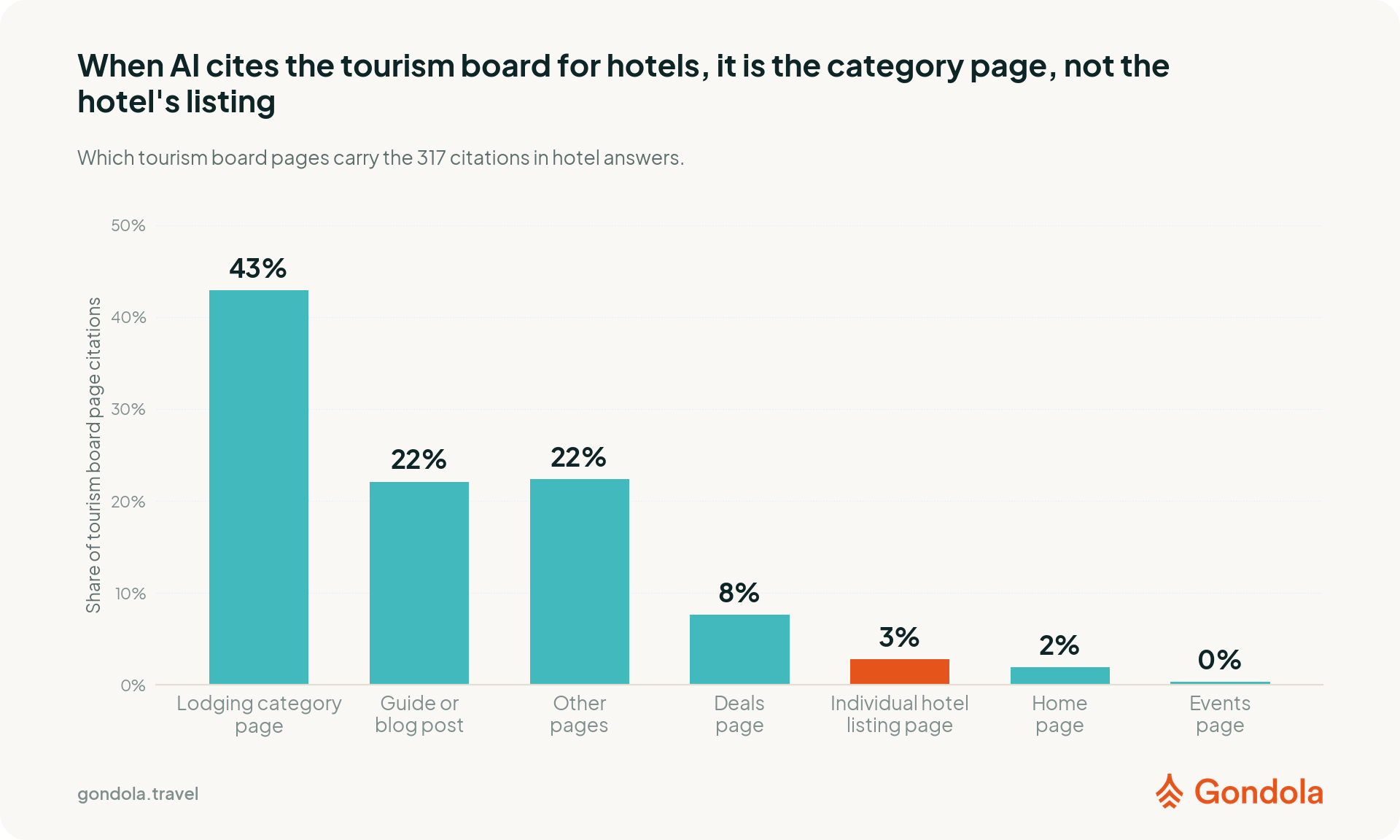
Page types among 317 citations to tourism sites in the separate hotel study.
When we asked for hotel booking links, only 6% of the returned answers cited a DMO. That does not tell us where anyone booked. It does show that being known as the official source is a long way from helping someone choose a specific property.
This should matter across the DMO’s work. Its site may help someone choose an area to stay in, yet say too little about the hotels there. Tours and hotels need different facts on their pages. Both need guests to understand their choices.
What I would ask a DMO to build
A DMO can put this influence to work by becoming the best source of truth about its place. I mean a directory with enough detail for people to make real choices, kept current by the businesses that know those details best.
For a tour or activity, that would include the exact experience, meeting point, duration, dates, age rules, access details, and a direct booking link. Hotels need their own fields for room types, location, access, and policies. The operator could send updates as things change. The DMO would check key facts, show when they were last checked, and link those records to its guides and trip-planning pages.
That is a fair exchange. Businesses give the DMO better information; the DMO gives visitors a better chance to discover what those businesses offer. It can build a resource that no one operator could build alone.
I would call that a democratic source of information. It does not require pretending every business is the same or promising everyone the same exposure. Every business that meets the rules should get a useful record and an easy way to fix it. Paid placements can be clearly marked. Payment should not decide whether a business is accurately described.
Start with one activity category and a question your visitor team hears often. Can someone use your site to compare all the eligible operators against their actual needs? Ask the operators to fill the gaps. Make the pages fast on a phone, readable in plain text, and easy to reach from the guides people already use.
Structured data can help describe a page where it fits, but Google says its AI search features require no special AI markup. Clear, useful pages still do not guarantee a citation. Google’s guidance is worth reading before buying a technical fix for what may be an information problem.
Then check the answers again. Look at which businesses are named, which pages are cited, and which facts are missing. Track visits and booking actions where you can. Members deserve an honest account of what is getting better and what you still cannot measure.
At the next board meeting, I would put that work in front of the people the DMO serves. Show them where the destination’s information is turning up. Show them which local businesses are well represented and which are barely described. Give the team the support to fix that. Making the whole place easier to understand and explore is work a destination organization can be proud to own.
Research note: The activity study reused 21 selected customer and prospect assessments with some overlapping places. The hotel study tested 21 selected destinations on one day. ChatGPT results came from an API with web search, not the consumer app. Both studies measured citations, not changes in travel or booking behavior. Operator examples are paraphrased from September calls and checked against their saved assessments; names are omitted. The recommendations are my judgment based on that work.
Research charts
The remaining charts add detail from two separate September 2026 studies. A citation means an official tourism website appeared as a source in an AI answer. It does not show what a traveler clicked or booked. Select a chart to open it at full size.
Tours and activities
Where tourism sites appear in activity answers
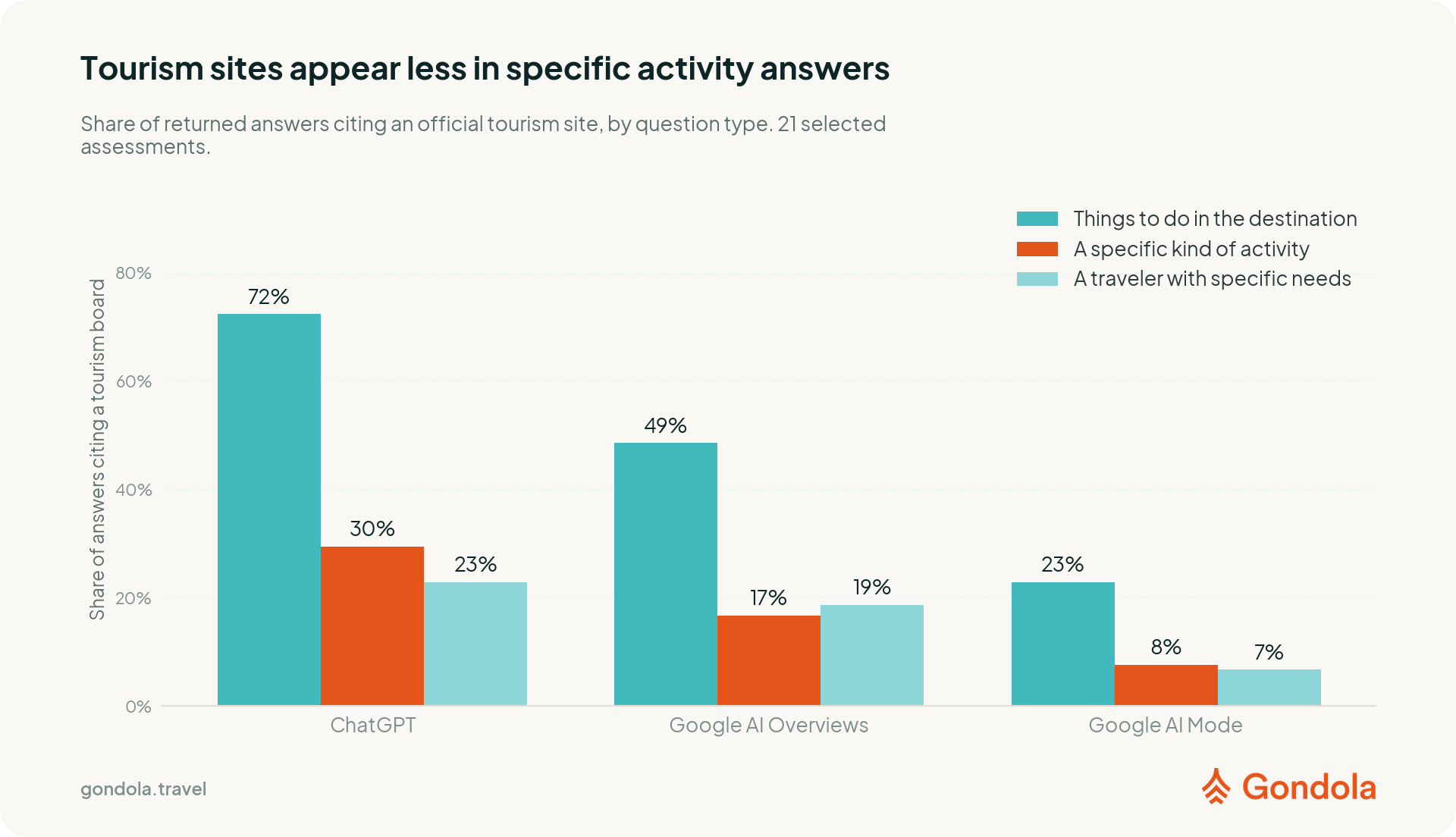
In 21 selected assessments, ChatGPT with web search cited tourism sites in 152 of 210 broad discovery answers, 31 of 105 specific activity answers, and 24 of 105 answers about traveler needs. These are separate question groups, not stages of one trip.
How prominent was the tourism site?
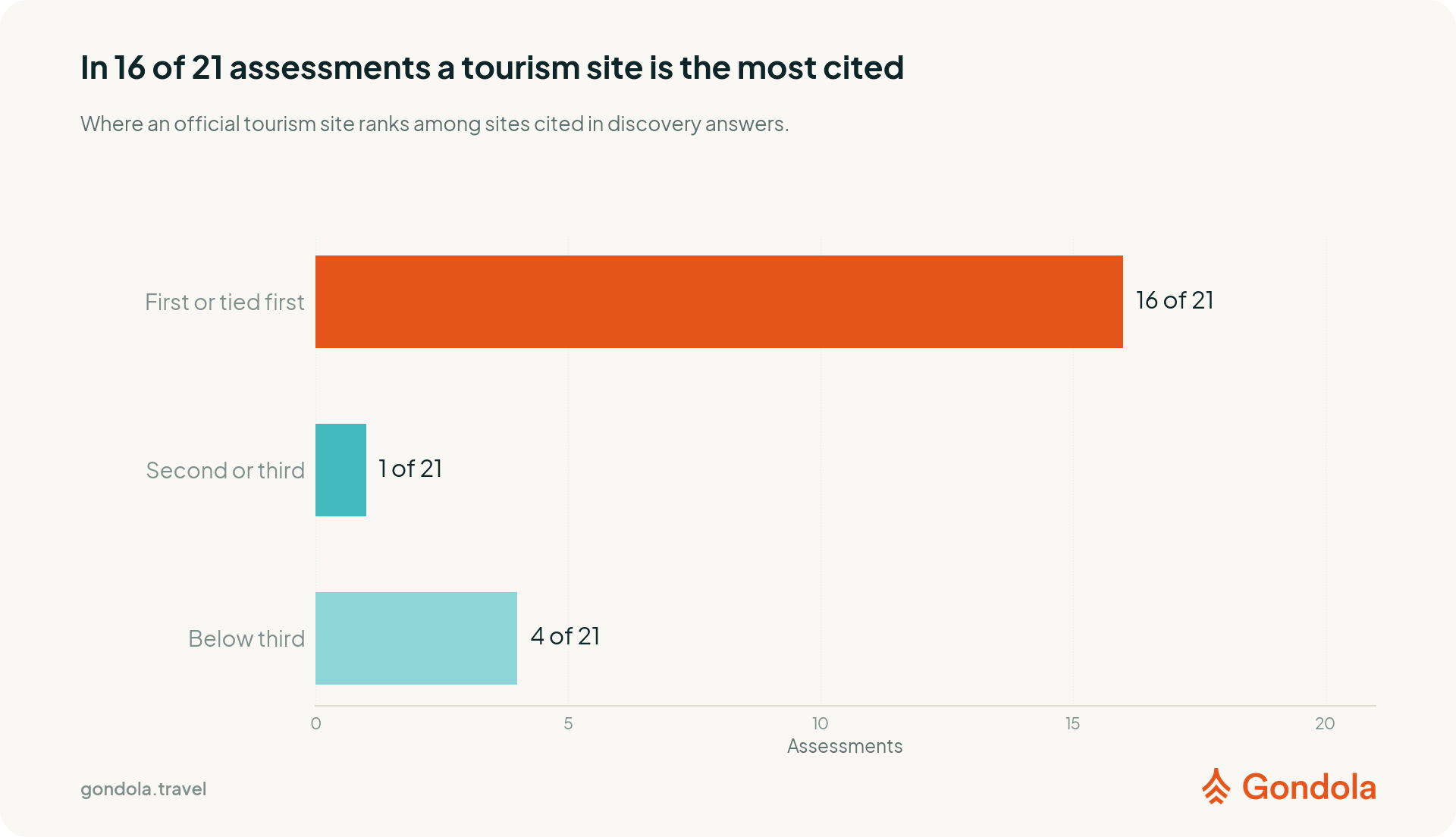
An official tourism site ranked first or tied for first among cited domains in 16 of the 21 selected discovery assessments. This ranks cited website domains in saved answers. It does not measure recommendation strength or visitor traffic.
One operator across ten cities
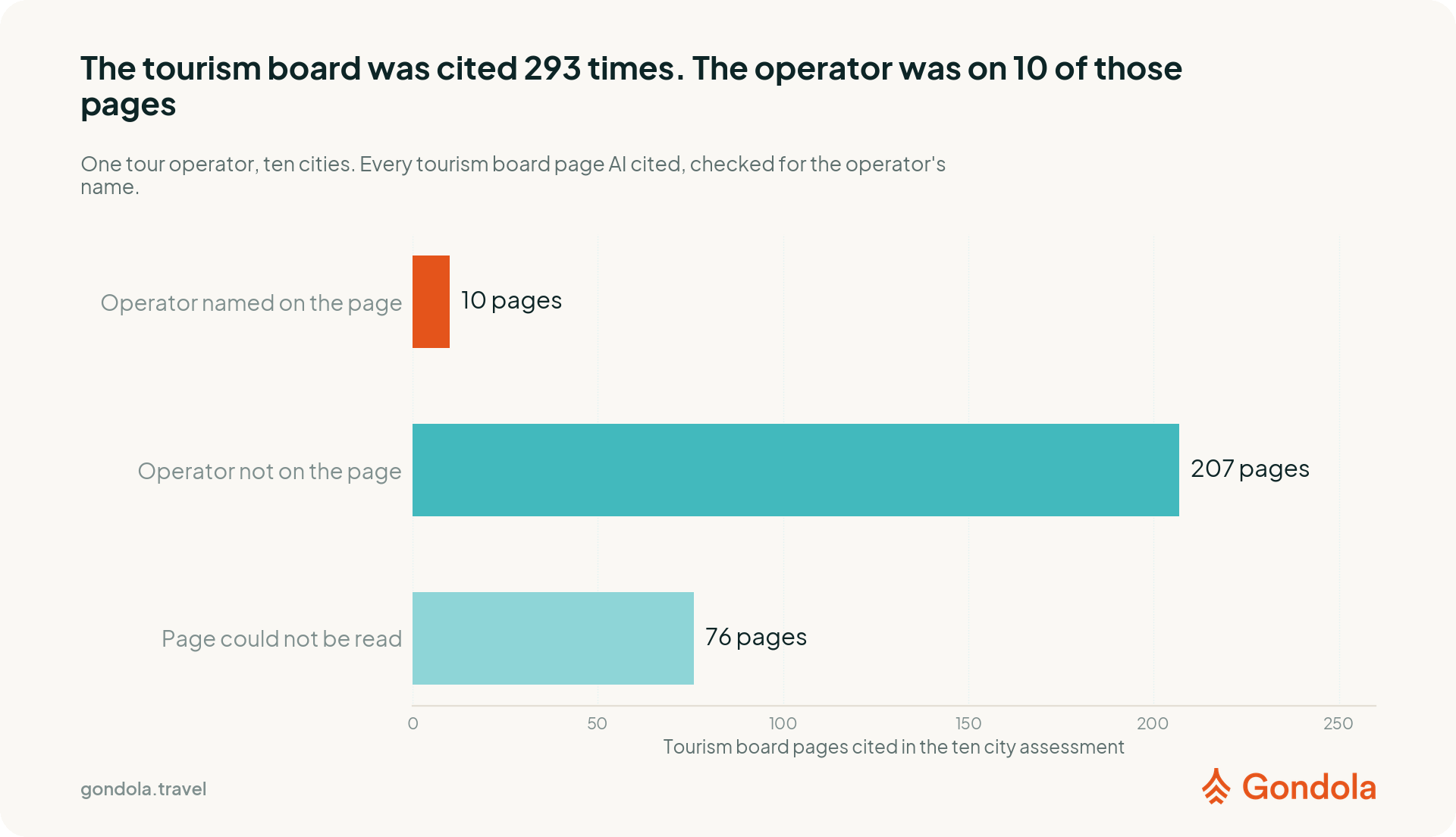
This is a separate example, not part of the 21-assessment chart above. AI cited 293 tourism page records in the ten-city assessment. The operator’s name was found on 10 of 217 readable pages and not found on 207. Another 76 pages could not be read. Automated checks can miss alternate names, so this example does not show how common the pattern is for all operators.
Hotels
The official site is known when asked for it
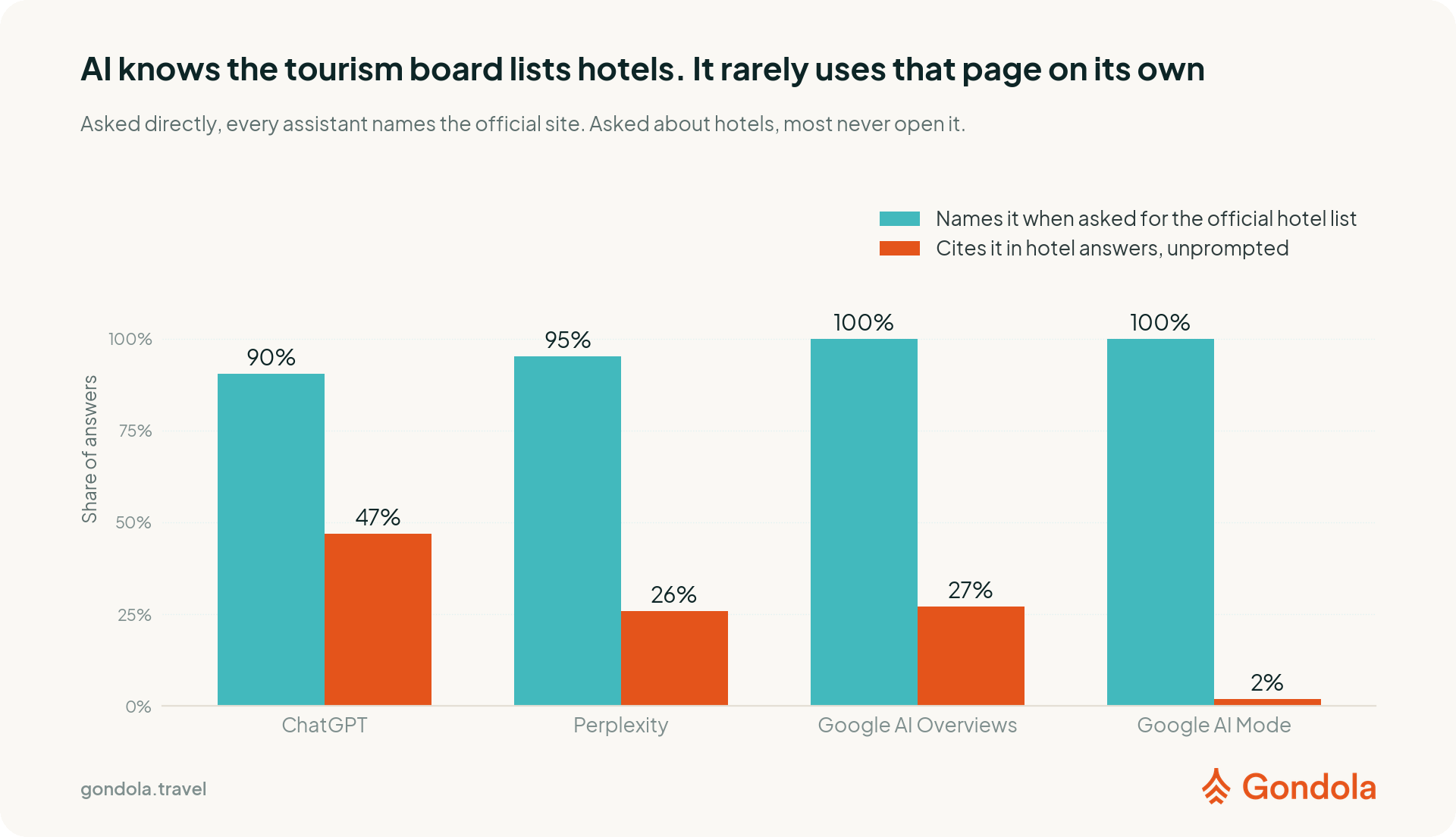
Across 21 selected destinations, 65 of 68 returned answers named or cited the official tourism site when asked whether it listed hotels. Unprompted hotel answers cited that site’s domain at different rates by surface: 47% on ChatGPT with web search, 26% on Perplexity sonar, 27% on Google AI Overviews, and 2% on Google AI Mode. Google AI Overviews returned only five answers to the official-site question, so its 100% bar rests on a very small count. These are different questions, not a before-and-after test.
Activities, hotels, and booking
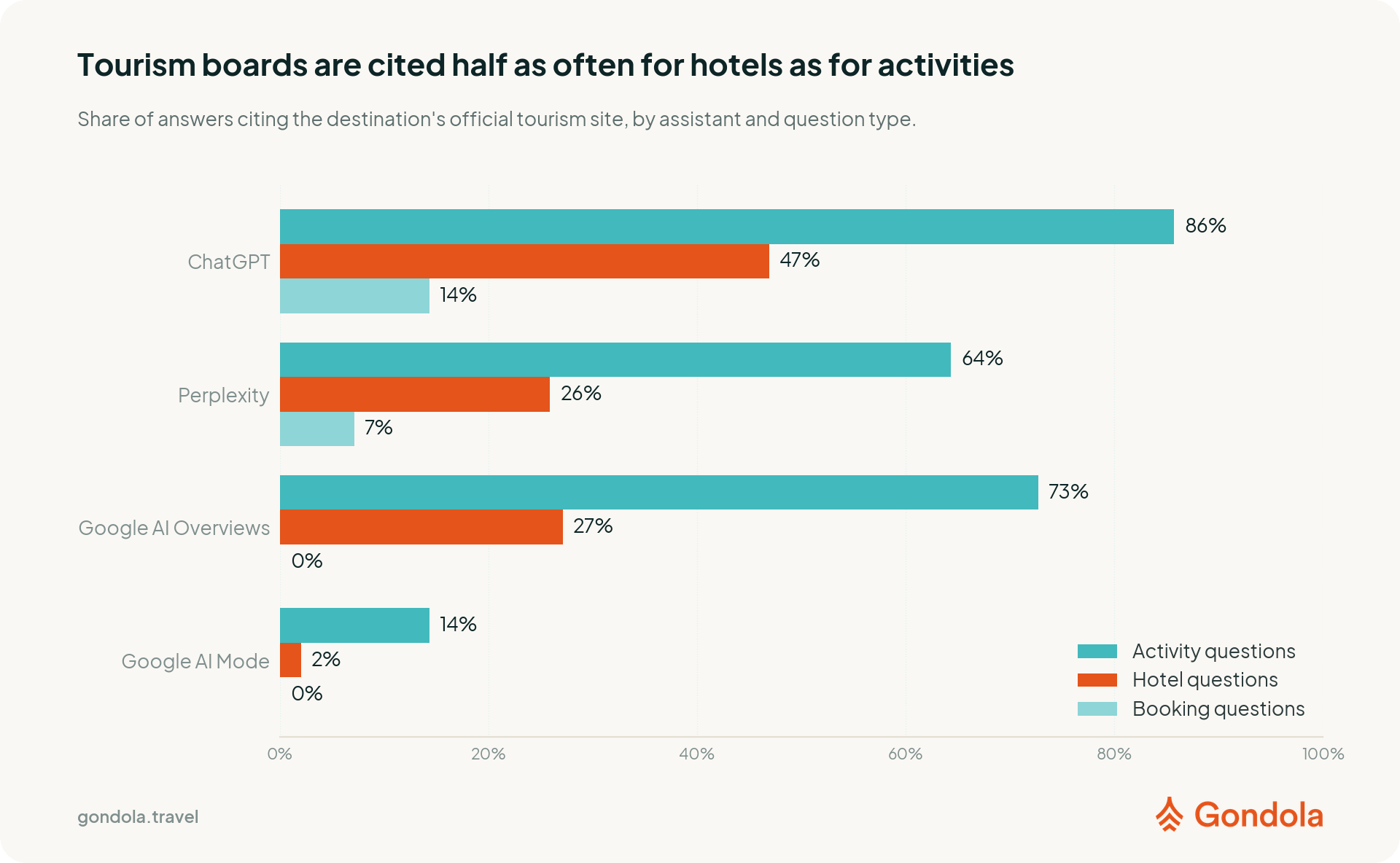
Within the hotel study’s selected questions, ChatGPT with web search cited the destination’s official tourism site in 86% of activity answers, 47% of hotel answers, and 14% of booking answers. The question groups differ in mix and size. Other AI surfaces show different rates. This measures citation presence, not the DMO’s effect on bookings.
Where hotel questions change
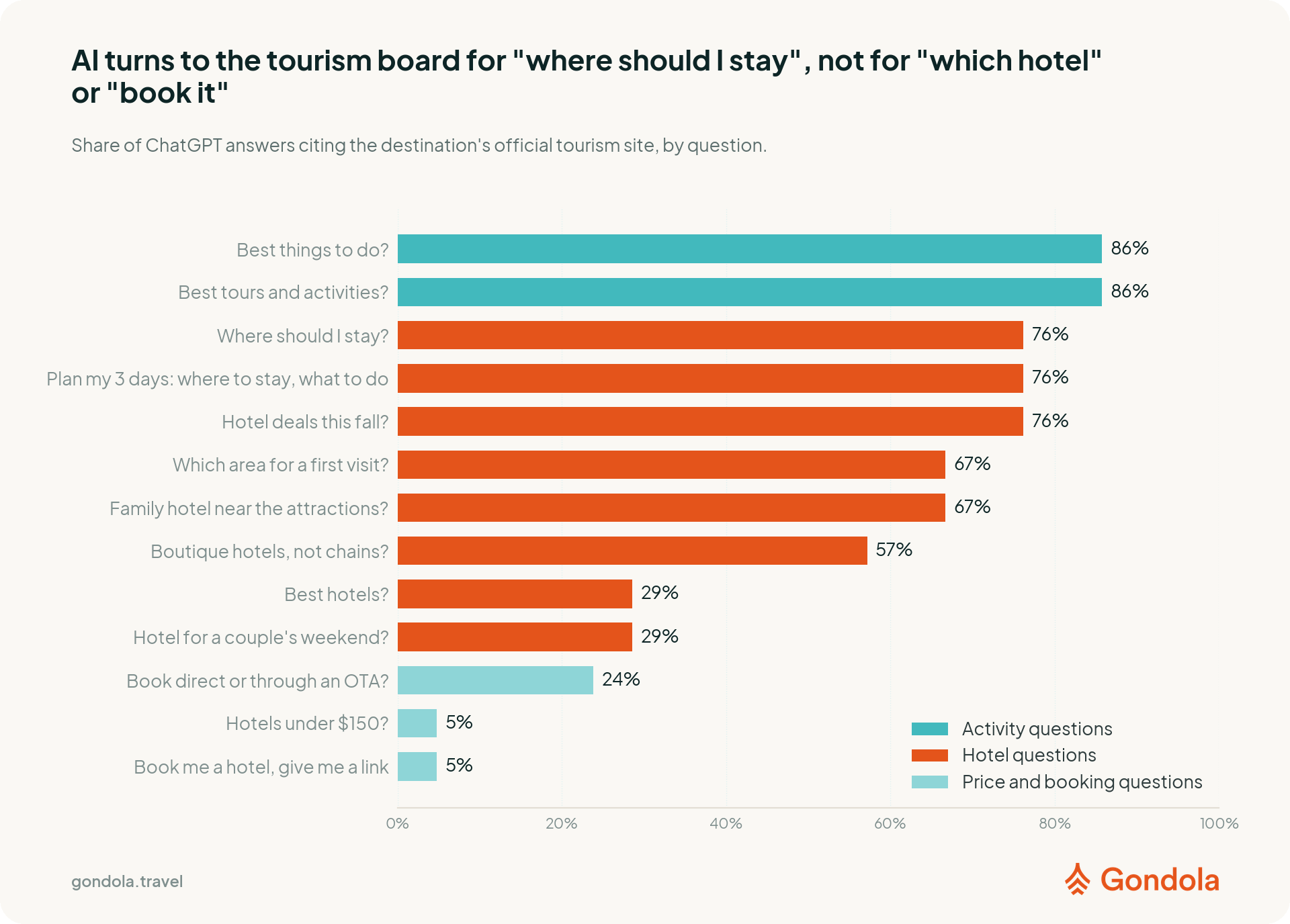
In the hotel study, ChatGPT with web search cited the DMO in 76% of “where should I stay” and trip-planning answers, 5% of price answers, and 5% of “book me” answers. These are different question sets, not a measured journey through one booking.
The domains cited most in hotel answers
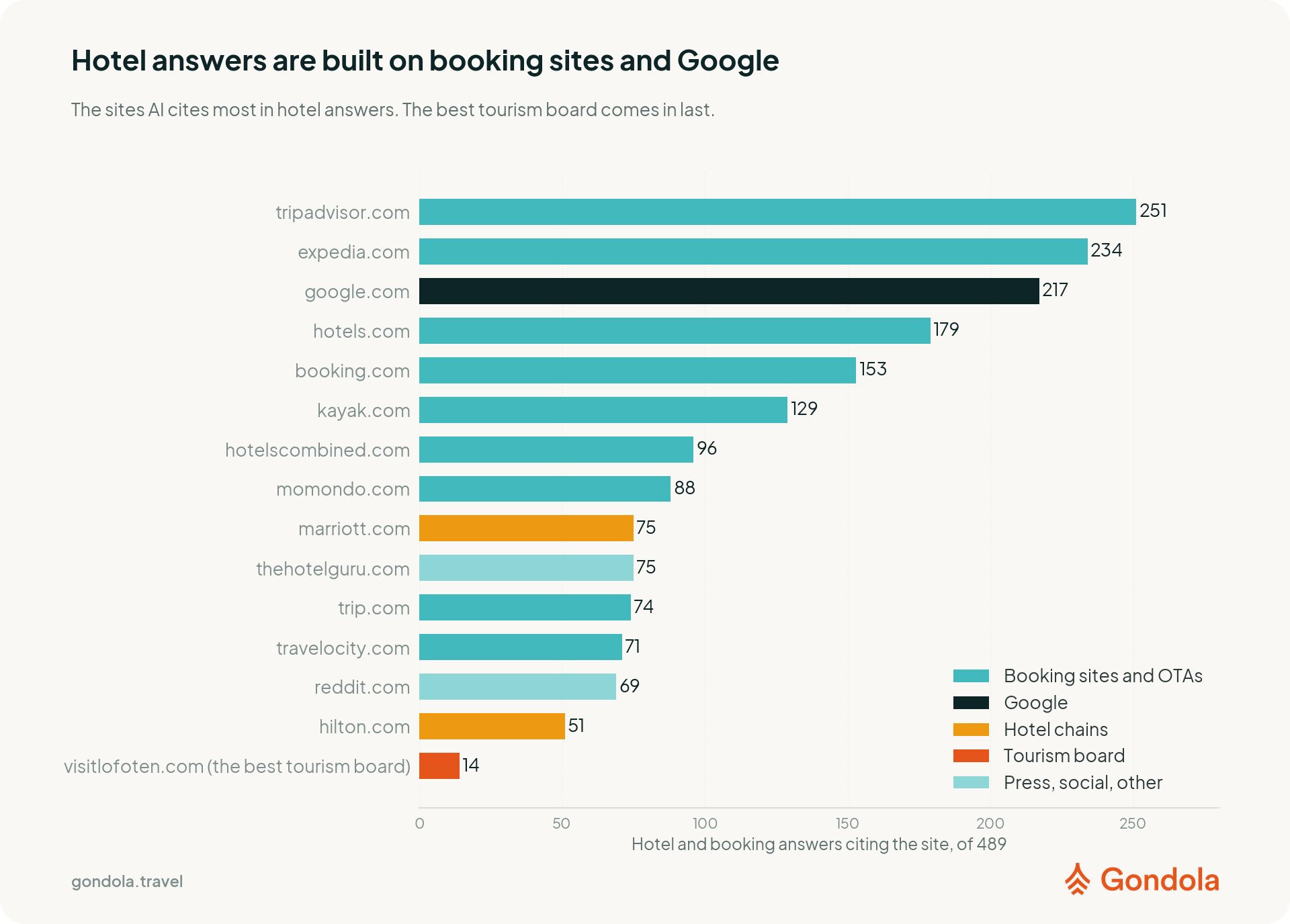
Across 489 hotel and booking answers, TripAdvisor, Expedia, Google, Hotels.com, and Booking.com led the cited domains. The chart counts cited domains, not clicks or bookings.
Where booking links went
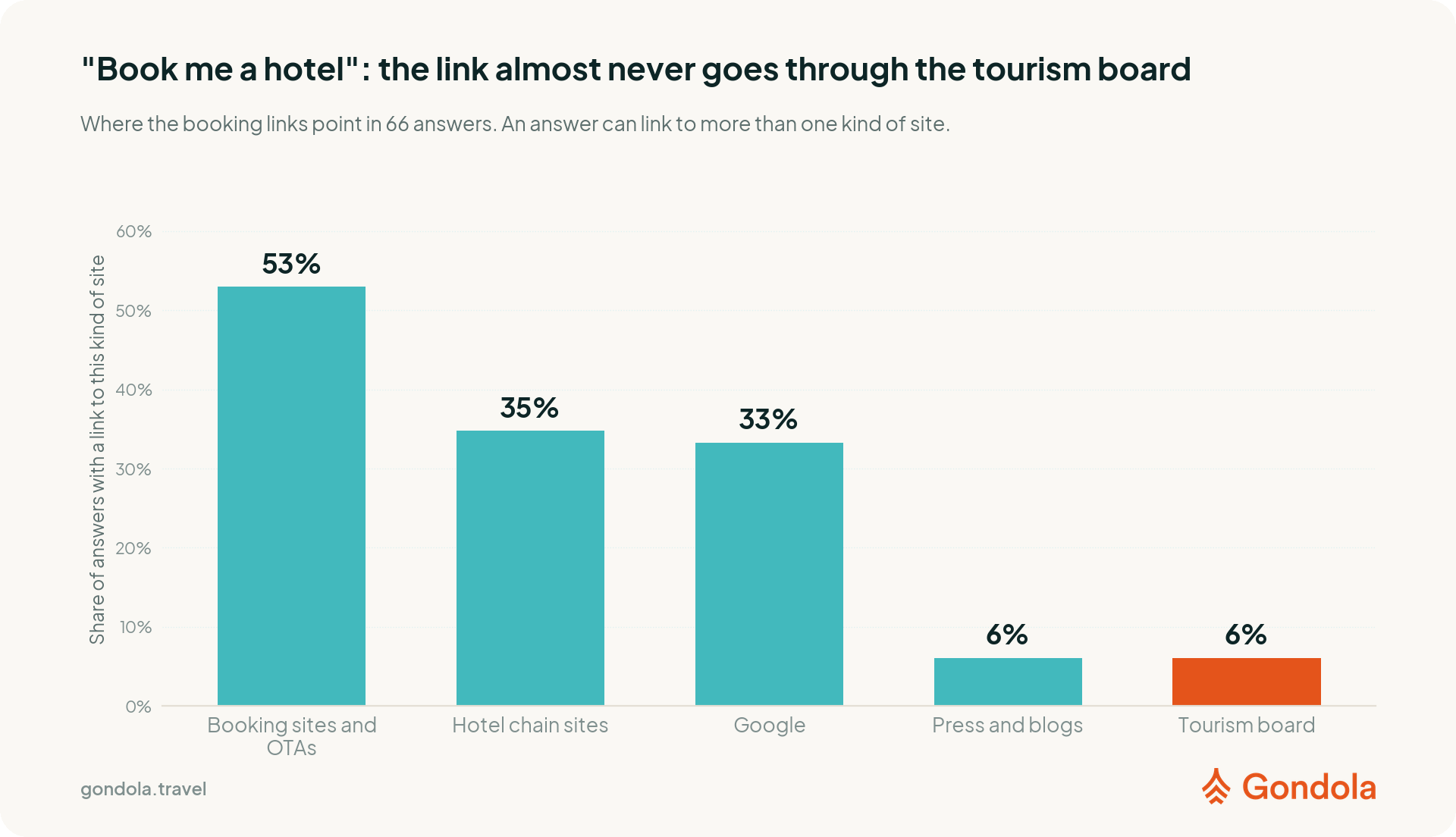
These shares come from 66 answers to one “book me a hotel” question. An answer can link to more than one kind of site, so the shares need not total 100%.
Independent hotels and chains
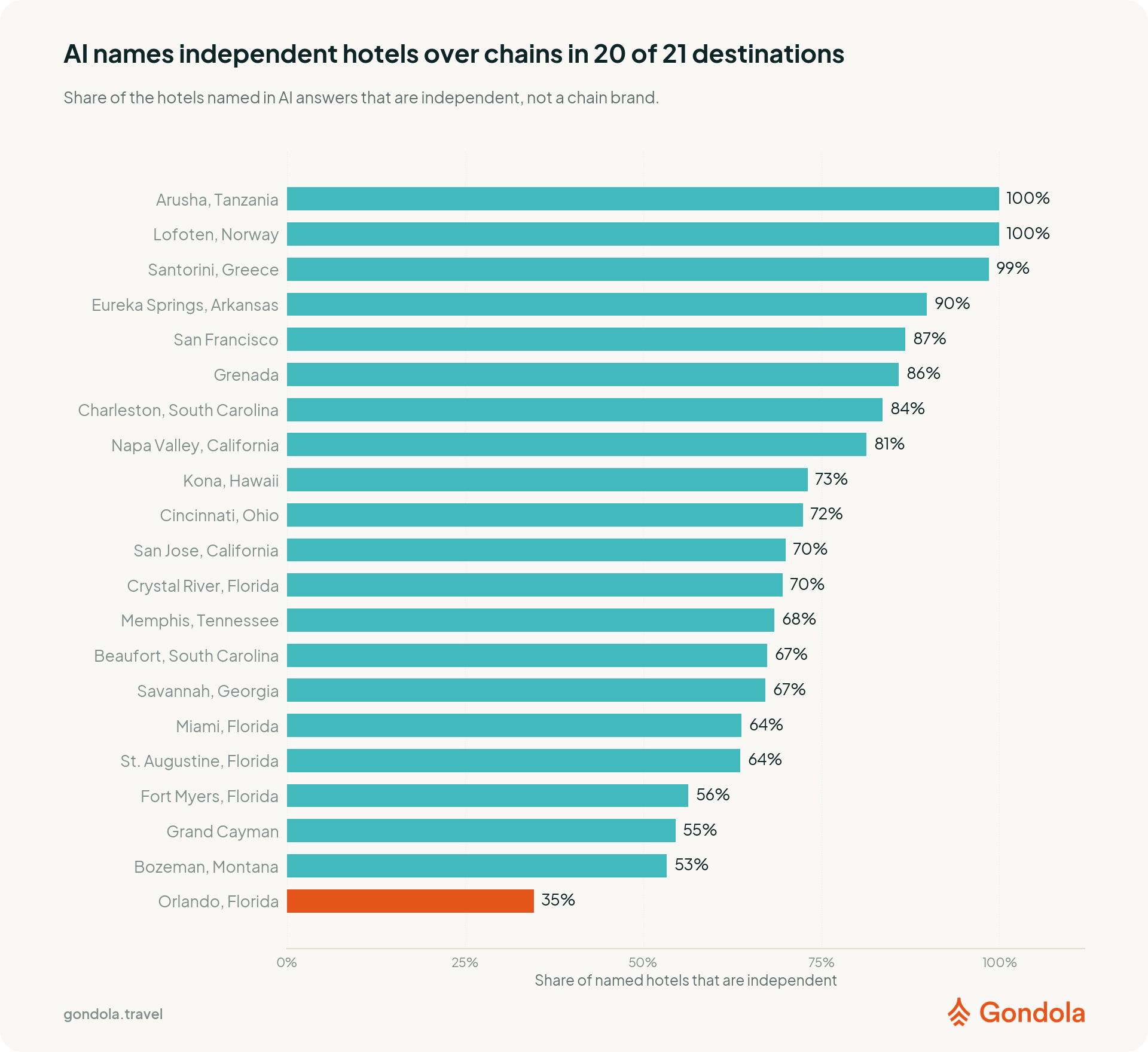
An automated name check found more independent-property mentions than chain-brand mentions in 20 of 21 destinations. Orlando was the exception. This is a count of names in answers, not bookings; name matching can misclassify properties.
Activity and hotel citations by destination
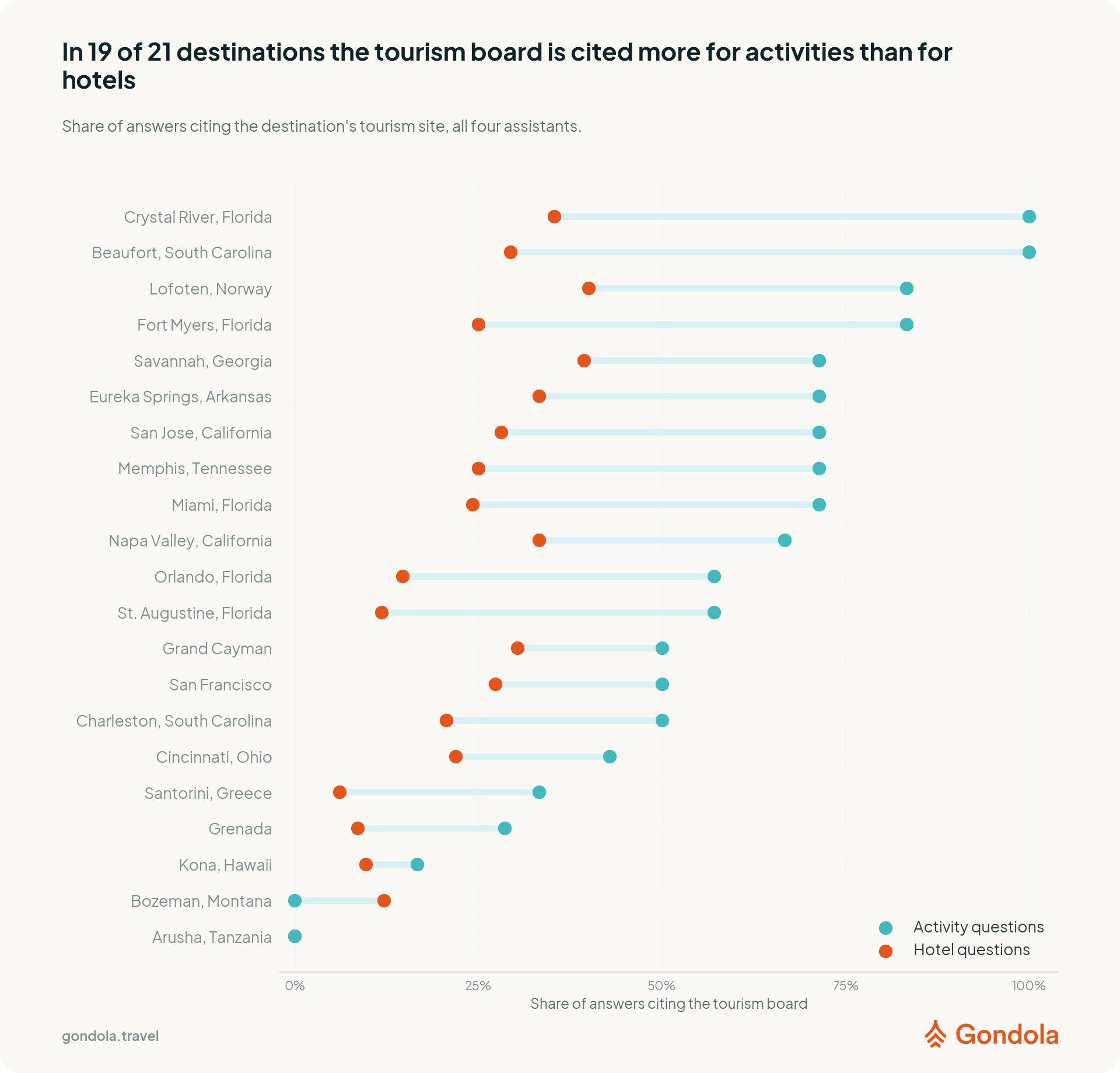
In 19 of 21 markets in the hotel study, DMO citation rates for activity questions were higher than for hotel questions. Bozeman went the other way; Arusha was zero in both. This compares two selected question groups, not all possible travel questions.
Estimated Google traffic, year over year
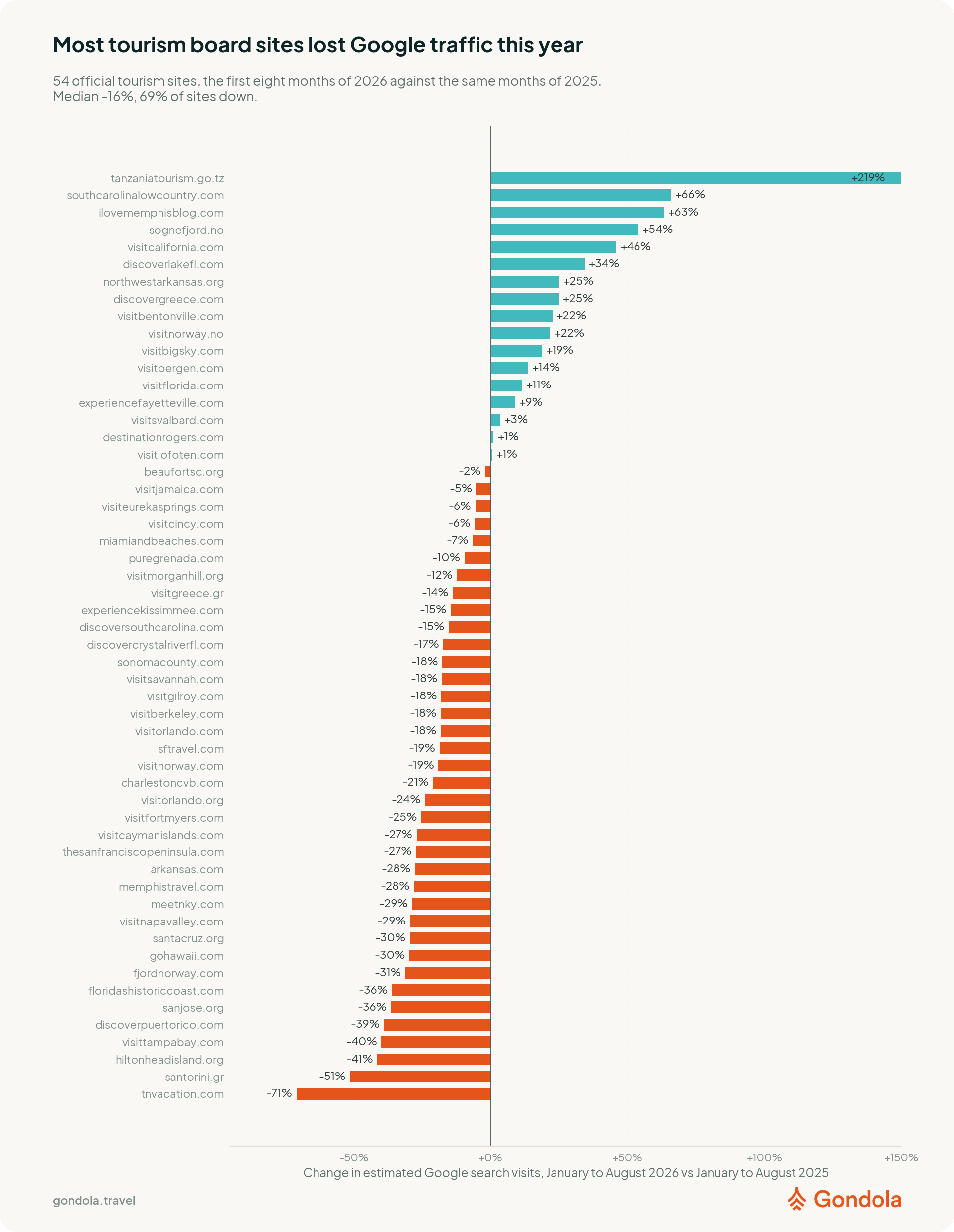
DataForSEO estimated lower Google organic traffic for 37 of 54 tourism domains, or 69%, in January–August 2026 versus the same months of 2025. The median estimated change was −16%. These are third-party estimates based on ranked keywords, not DMO analytics or proof that AI caused the change.
Estimated traffic over time
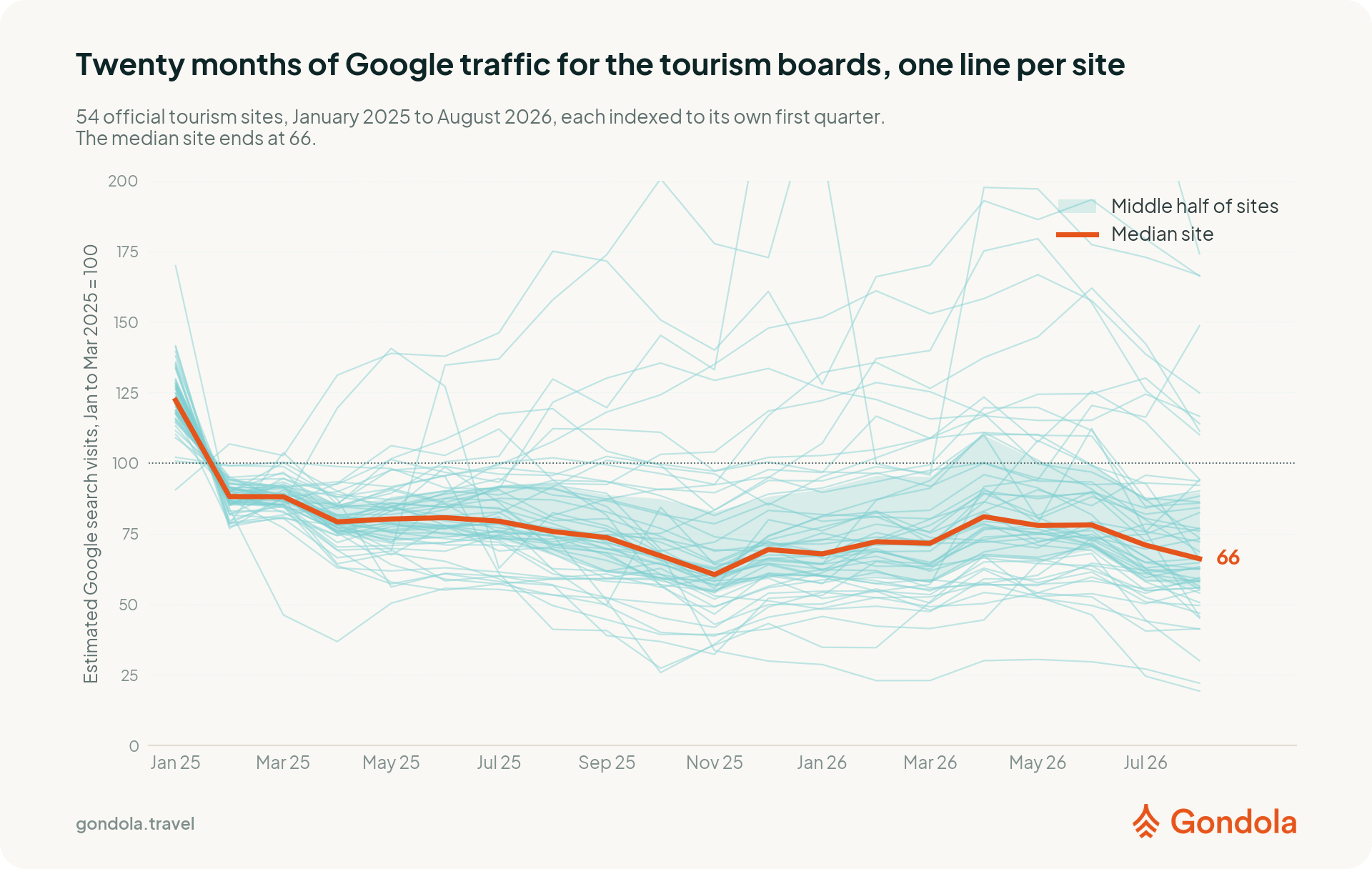
Each site is indexed to its own starting level. The median ended August 2026 at 66. This is the same third-party traffic estimate, not a measure of AI referrals.